
Sentiment Overview
Sentiment is the tone the AI takes when talking about your brand. Scout classifies every mention as positive, neutral, or negative — giving you the earliest possible warning when public perception shifts.
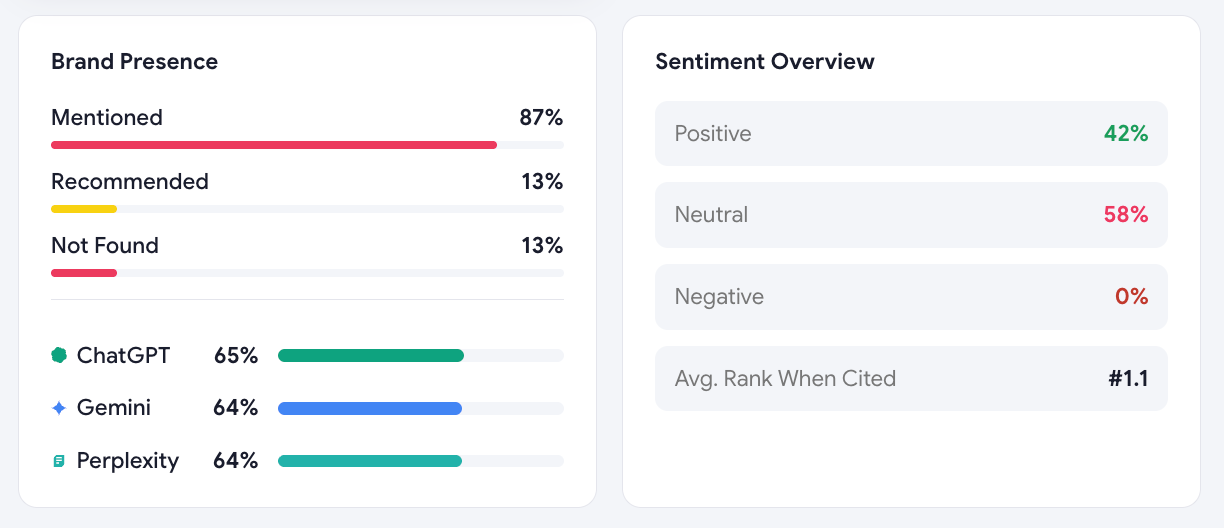
How sentiment is detected
For each AI response that mentions your brand, the analysis pass (gpt-4o-mini) reads the surrounding
context and emits one of three labels. The classification considers:
- Adjectives near your brand name ("excellent", "limited", "overpriced")
- Comparative framing ("better than X" vs "not as good as X")
- Recommendation language ("we'd recommend" vs "you might consider")
- Caveats and qualifiers ("great, but..." → neutral, not positive)
Five-class sentiment (very negative, negative, neutral, positive, very positive) sounds more sophisticated but introduces noise — different AI models disagree on the boundaries. Three classes are stable, comparable across models, and produce a sentiment score that actually trends.
How sentiment maps to score
Sentiment contributes 15 of the 100 Visibility Score points:
- Positive mention → 1.0
- Neutral mention → 0.5
- Negative mention → 0.0
The sentiment component of your score is the average across every mention, multiplied by 15.
Reacting to sentiment changes
-
Negative spike — investigate immediately
Open AI Responses, filter sentiment to "Negative", and read every response. Look for a recurring theme — "slow support", "expensive", "missing feature X" — that's the root cause.
-
Slow drift downward — it's positioning
If sentiment is gently sliding without a single spike, your brand voice is being out-positioned by competitors. Read which competitor reasons are appearing most often and adjust your messaging to neutralise them.
-
Suddenly more neutral, less positive — citation problem
Check Cited Sources. If the AI has stopped quoting your strongest reviews and started quoting generic sources (Wikipedia, your homepage), it's lost its enthusiasm. Push fresh case studies and testimonials.
AI models retrain on a delay, so sentiment changes slowly. Don't panic over a one-scan dip — look for trends across 3+ scans before changing strategy.
Was this page helpful?
Thanks for the feedback — we read every response.