New · Prompt Discovery

Find buyer questions sized by
real Google search demand

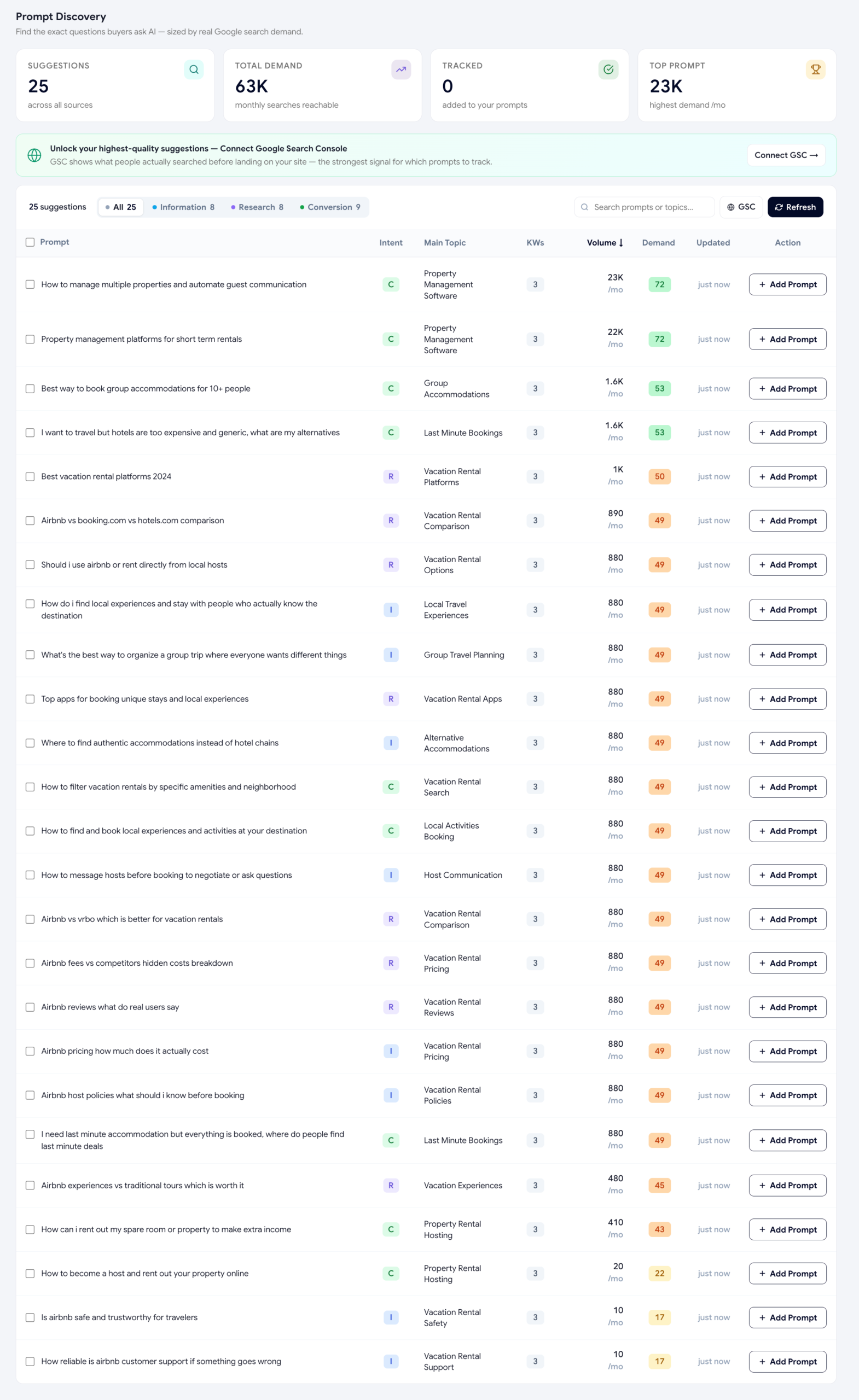
Stop guessing which AI prompts to track. Scout finds them across six sources, classifies intent, and pairs every prompt with real Google Keyword Planner volume, so you rank by market opportunity, not gut feel.

Prompt Discovery page with intent badges, demand heatmap and bulk-add bar
What's Different

Every other AI tracker shows mention counts.
Scout shows market opportunity.

Real Google search volumes pulled from the Keyword Planner: not estimates, not vibes.

Other AI tools give you:

  • "You got 12 mentions this week," with no context
  • No way to size which prompts actually matter
  • Vibe-based intent classification, or none at all
  • Everything tracked at once, so you drown in noise
  • Vanity metrics on a dashboard

Scout's Prompt Discovery gives you:

  • Real Google search volume for every prompt
  • A Demand Score, 0 to 100, for instant ranking
  • Three-bucket intent classification: Information, Research, Conversion
  • The ability to filter to Conversion, sort by demand, and ship
  • Business metrics, like "287K searches reachable"
Where Prompts Come From

Six sources, one ranked feed

Scout combines AI-generated prompts with real buyer language from Reddit, Search Console, and the open web.

🤖
Claude (AI)
Buyer-intent prompts brainstormed from your brand and topics.
Perplexity
Real questions people ask conversational AI.
People Also Ask
Google's PAA expansions for your category.
🔍
Autocomplete
Search-bar suggestions for your keyword seeds.
🟠
Reddit
Question titles from relevant subreddits, weighted by upvotes.
📊
Search Console
Real queries already driving impressions to your site.
Three-Bucket Intent Classification

Know exactly where each prompt sits in the funnel

Every element is automatically classified into one of three buying-intent buckets, so you can prioritize by funnel stage.

I

Information

Phrases like "what is," "how does," or "explain" mean the user is learning. Track these to build authority and capture top-of-funnel awareness.

R

Research

Phrases like "best," "vs," "compare," or "review" mean the user is evaluating. Track these to win the head-to-heads against your competitors.

C

Conversion

Phrases like "pricing," "buy," "sign up," or "demo" mean the user is ready to act. This is the highest-ROI bucket: fewer queries, but each one is a buyer.
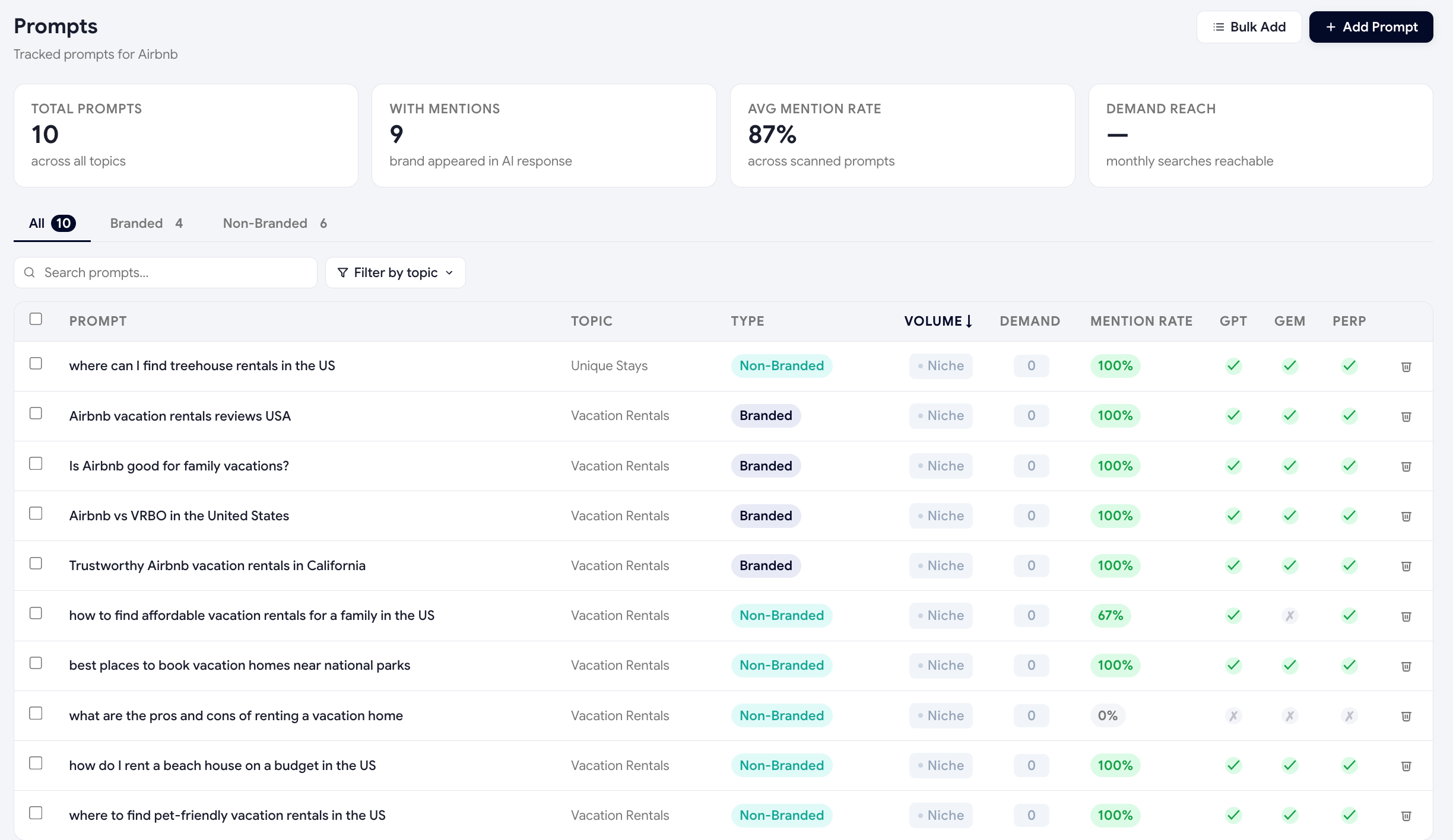
Demand Score, 0 to 100

A logarithmic score of real search demand

A color-coded heatmap runs from gray (Niche) through yellow and orange to green (Excellent). Click the column to sort.

Tracked prompts with Volume and Demand columns sorted by highest demand

Volume and Demand follow your tracked prompts everywhere in the app: the Prompts page, the Dashboard, and Reports.

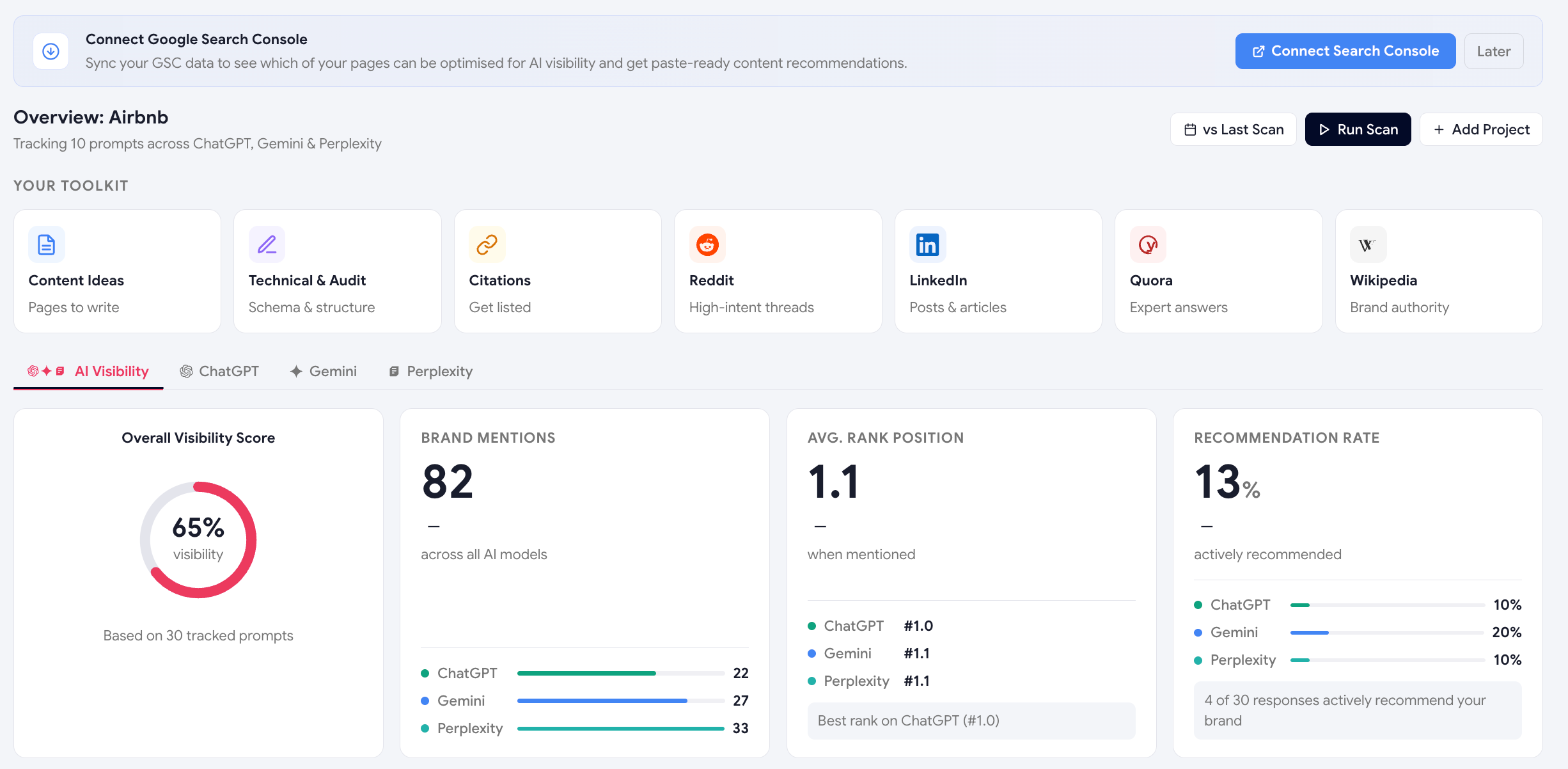
Demand Reach

Frame your AI work as market opportunity

"We grew share of voice on prompts representing 287K monthly searches" hits harder than "we got 12 mentions this week."

Dashboard with Demand Reach hero strip showing total reachable monthly searches
FAQ

Common questions about Prompt Discovery

Where does the search volume data actually come from?

Every prompt in Discovery is matched against real Google Keyword Planner data, the same source advertisers use to plan search campaigns. It's not an estimate or a proxy metric; it's the actual monthly search volume for the closest matching query.

How is the Demand Score different from raw search volume?

Raw search volume can range from single digits to millions, which makes side-by-side comparison difficult. Demand Score compresses that range into a 0 to 100 logarithmic scale, so a prompt with 500 searches and one with 50,000 searches can both be ranked on the same heatmap without the smaller one disappearing.

Can I track a prompt that has low or no measurable search volume?

Yes. Not every valuable prompt shows up in Keyword Planner, especially newer or highly specific questions. You can still add and track any prompt manually; the Demand Score and Volume columns just won't populate for queries with no measurable Google search data.

What's the difference between Research and Conversion intent, and does it matter which I track?

Research prompts are comparison and evaluation queries, like "best" or "vs," where the user is still choosing between options. Conversion prompts are closer to a purchase decision, like "pricing" or "sign up." Both matter: Research is where you win against competitors, Conversion is where you catch buyers closest to acting, and most brands need visibility in both buckets.

Do the six discovery sources update automatically, or do I need to re-run discovery manually?

Discovery sources refresh each time you run it, pulling current data from Claude, Perplexity, PAA, Autocomplete, Reddit, and Search Console. You can re-run discovery whenever you want a fresh batch of candidate prompts, and previously added prompts stay tracked independently.

Is Prompt Discovery available on the Free plan?

Yes. The free trial includes 5 tracked prompts and full access to Prompt Discovery, so you can see the intent classification and demand scoring before deciding on a paid plan.

Find the prompts worth your time

Free trial includes 5 tracked prompts and full access to Prompt Discovery.
No credit card required.