

Citation in SEO: a guide for the local SEO and AI search era
Ask most marketers what a citation is and you’ll usually get the same answer: a directory listing with a business name, address, and phone number. Fair enough, but that’s only half the story now. It covers Google Maps and misses everything that happens when someone types a question into ChatGPT or Perplexity instead.
So this guide covers both. The old local SEO layer, built on NAP data (name, address, phone), and the newer layer built around how AI models pull content and decide what gets credited. Most articles online only bother with one. Knowing how the two connect is where the advantage is right now.
Key takeaways
- A citation is any consistent, verifiable reference to a business’s identity (name, address, phone) — with or without a link.
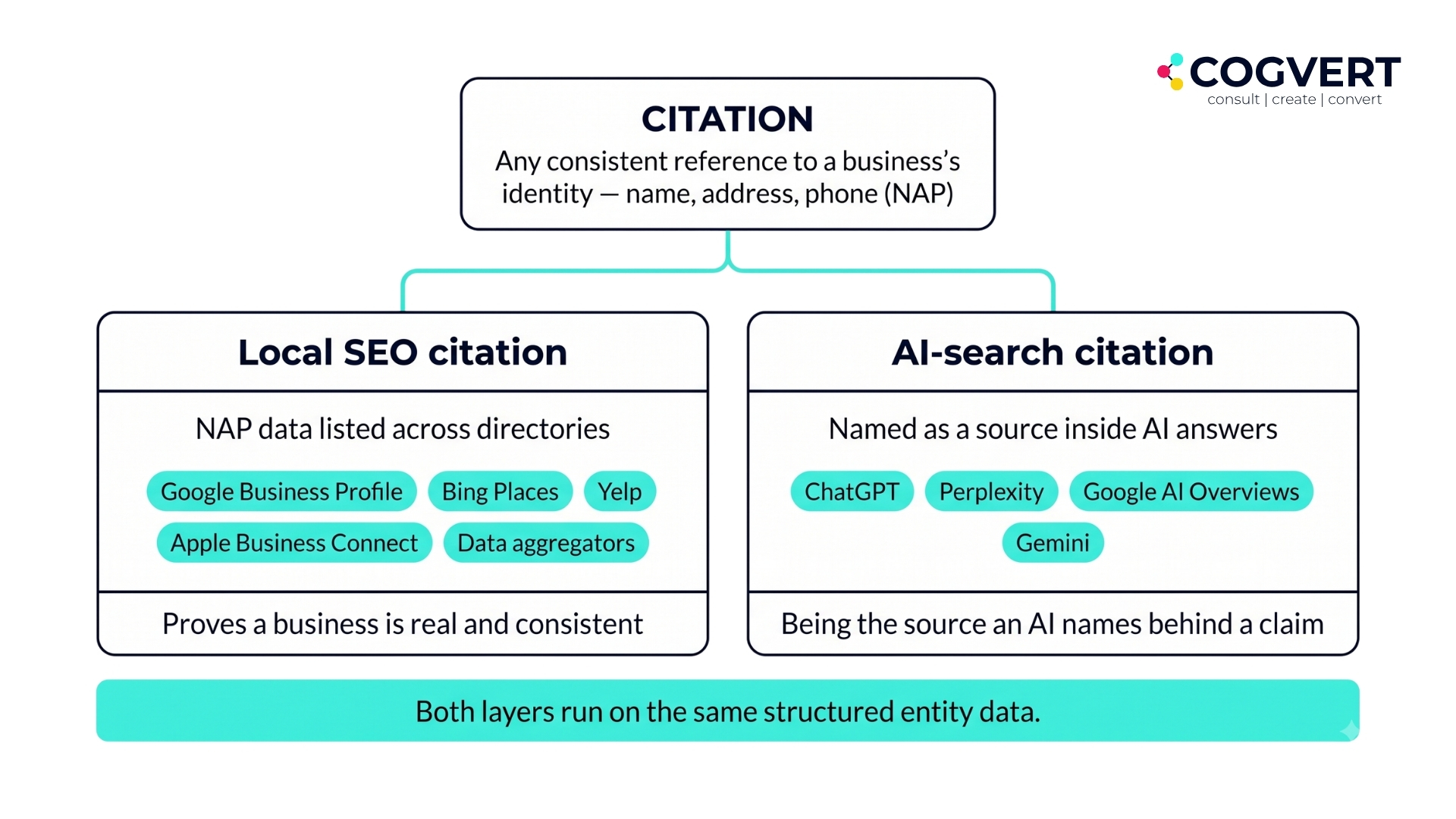
- The word now carries two meanings: the local-SEO citation (NAP data) and the AI-search citation (being named as a source by ChatGPT, Perplexity, Google AI Overviews and Gemini).
- For local SEO, NAP consistency — not citation volume — moves rankings, and the same structured data increasingly feeds AI answers.
- For AI citations, extractable structure, corroboration and freshness beat raw writing quality; placement cannot be bought or guaranteed.
Definition
A citation in SEO is any consistent reference to a business’s identity — its name, address and phone (NAP) — anywhere online or offline, with or without a link. The term now splits two ways: the local SEO citation (NAP data across directories) and the AI-search citation, when an answer engine such as ChatGPT, Perplexity or Google AI Overviews names a source behind a claim.
What is a local SEO citation?
A citation, in the classic sense, is any reference to a business’s identity, usually name, address, and phone number, wherever it shows up online or off. No link required. It doesn’t even need to sit in a directory. A newspaper piece naming a shop and its neighbourhood counts. So does a podcast show note listing a sponsor’s address, or an entry buried in a government business registry.
People treat “citation building” and “directory submission” as the same thing constantly, and they’re not. Directory submission is just one tactic for generating citations.
Why Search Engines Bother With This at All
Search engines need some way to confirm a business is real, still open, and where it says it is. A business claiming things about itself on its own website isn’t strong proof of anything. Ten independent, consistent mentions scattered across unrelated sites? That’s much harder to fake. A citation is basically corroboration. The engine isn’t asking whether the business claims to be real, it’s asking whether the rest of the internet backs that up.
Hold onto that idea. It’s the thread connecting the old definition to the new one.
Structured vs. Unstructured Citations
| Criterion | Structured citations | Unstructured citations |
|---|---|---|
| Format | Fixed, labelled fields (name, address, phone, category, hours) | Free text inside ordinary content |
| Where they appear | Google Business Profile, Bing Places, Yelp, Apple Business Connect, industry directories | Blog posts, news stories, forum threads, reviews |
| Who creates them | Submitted on the business’s behalf | Written independently by third parties |
| Trust signal | Easy for crawlers to parse | Often weightier — reads as organic, not self-reported |
| Healthy profile | Both are needed — all-structured looks manufactured | Both are needed — the mix signals a real, talked-about business |
The Main Types of Citations
Beyond structured and unstructured, citations also split by where they come from.
- General directories: Broad, cross-industry platforms like Yelp, YellowPages, Better Business Bureau, Manta.
- Data aggregators: Large providers such as Data Axle, Foursquare, and Neustar Localeze. They don’t face consumers directly. Instead they feed hundreds of downstream apps, GPS systems, and smaller directories automatically. This layer gets misunderstood more than any other part of citation strategy, which is why it gets its own section further down.
- Vertical directories: Built for one profession. Avvo for lawyers, Healthgrades or Zocdoc for medical providers, Houzz for contractors, OpenTable for restaurants. Google weighs these fairly heavily since the relevance within the category runs high.
- Local and hyperlocal directories: Chamber of Commerce listings, city tourism boards, neighbourhood associations, local news outlets.
- Social platforms: Facebook, Instagram, LinkedIn business pages, when they show address and phone info.
- Print-to-digital archives: Old phone books and newspapers that got digitised and indexed. Sometimes still carrying an outdated address that quietly drags down consistency scores years later.
What is citation building in SEO?
Citation building in SEO is the process of earning consistent NAP references across directories, aggregators and independent content — not just submitting to directories. Directory submission is one tactic inside citation building, not the whole of it. For an established business, building citations means correcting and consolidating what already exists before adding anything new.
Why NAP consistency drives local SEO citation rankings
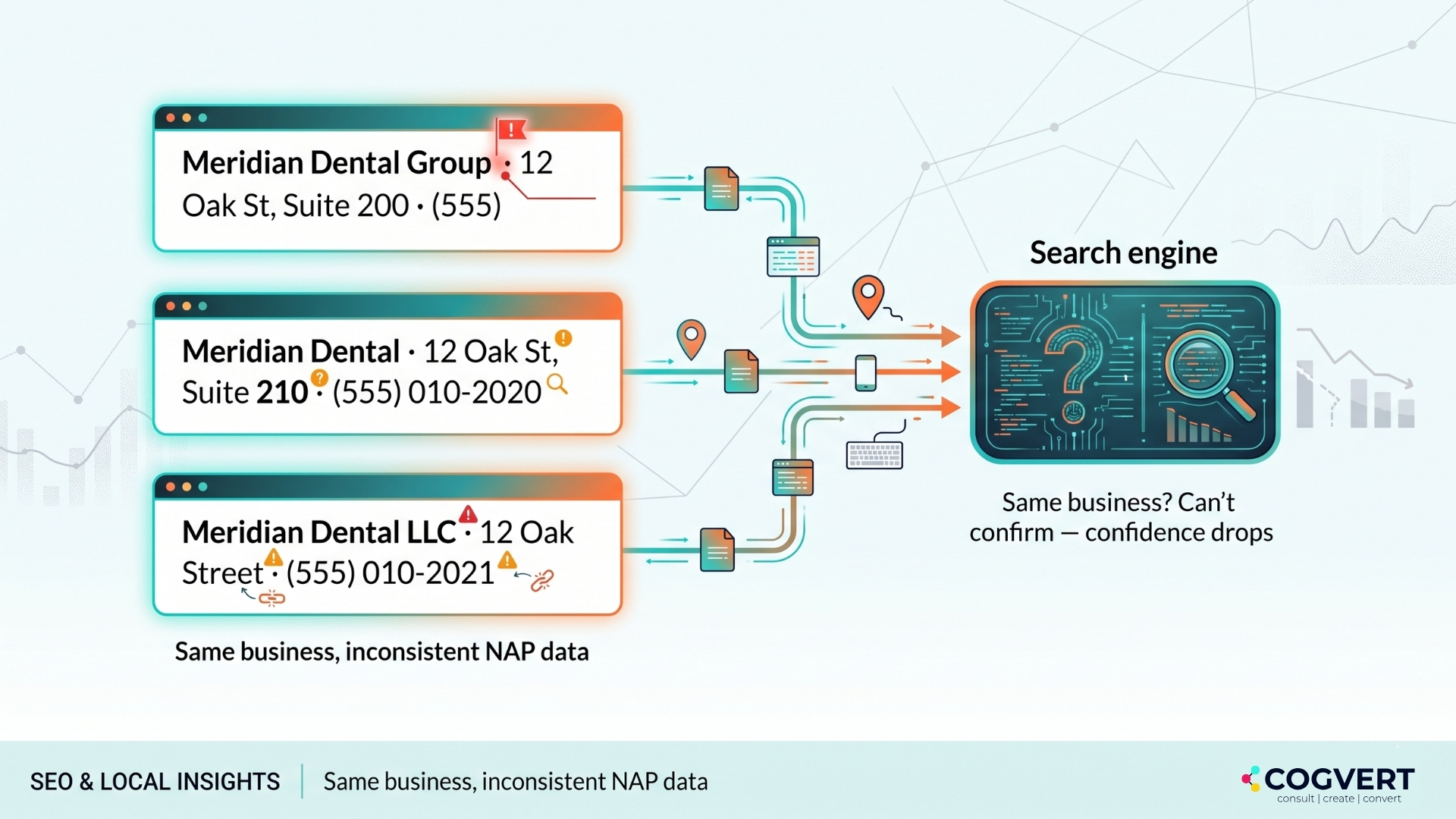
Volume isn’t the lever here. Consistency is. Say a business shows up as “Meridian Dental Group” on one listing, “Meridian Dental” on another, and “Meridian Dental LLC” on a third, with two different suite numbers still floating around from an old office move. Now the search engine has an entity-resolution problem. It can’t fully confirm these all point to the same business, and that uncertainty gets baked into how confidently it ranks the business locally.
Think of it less as a running point total and more as a trust threshold. Below it, inconsistent data actively suppresses visibility, because the engine hedges against showing an uncertain answer to someone who just wants directions or a phone number. Above it, piling on more citations barely moves anything.
Audits turn up cases like this more often than you’d think: correcting 12 inconsistent listings, without adding a single new citation, moved a business from position 6-7 in the map pack up to 2-3, in about 6 weeks. No new links. No new content. Just cleaning up what was already there. That example makes the point better than any volume-based advice could. For a business more than a couple of years old, cleanup usually beats expansion, because address changes, rebrands, and ownership transfers all leave noise behind whether anyone notices or not.
The Data Aggregator Layer
Aggregators like Data Axle, Foursquare, and Neustar Localeze don’t serve end users at all. They sit upstream and feed data into hundreds of smaller apps, GPS systems, voice assistants, and niche directories, on a recurring sync.
Submit correct NAP data once to a paid aggregator and it ripples out across dozens of platforms with zero further work on your end. Submit wrong data and the same thing happens in reverse. Now you’re fighting the same mistake on forty different sites instead of just fixing it once at the source. Any serious citation strategy starts here, before anyone touches an individual directory.
Citations vs. Backlinks
| Criterion | Citation | Backlink |
|---|---|---|
| What it is | A data reference to a business’s identity (NAP) | A hyperlink from one site to another |
| Primary value | Consistency + corroboration of a real-world entity | Authority transfer + topical relevance |
| Needs a link? | No | Yes — it is the link |
| What it proves | The business is real and its details agree across sources | One site vouches for another’s content |
| Overlap | A directory listing that links back counts as both | A directory listing that links back counts as both |
This trips people up because chasing high-authority backlinks while ignoring NAP accuracy misses what’s actually driving local rank confidence.
What “Citation” Means in AI Search
Somewhere around 2025, heading into 2026, a second and pretty different meaning of “citation” took hold. When ChatGPT search, Perplexity, Google AI Overviews, or Gemini answer a question, they’ll often name a specific source, page, or brand as where a claim came from. Sometimes with a link, sometimes not. People call this an AI citation now, and the practice built around earning them has picked up its own label: Generative Engine Optimization, or GEO, sometimes folded into the wider term AI Optimisation.
It’s tempting to treat this as local citation building with a new coat of paint. It isn’t. It runs on a genuinely different mechanism, and pretending otherwise is a good way to burn a budget.
How Generative Engines Decide What to Cite
At Cogvert, we’ve tracked citation behaviour across Google AI Overviews and Perplexity for client content since 2024, and a handful of patterns show up often enough to count as working rules.
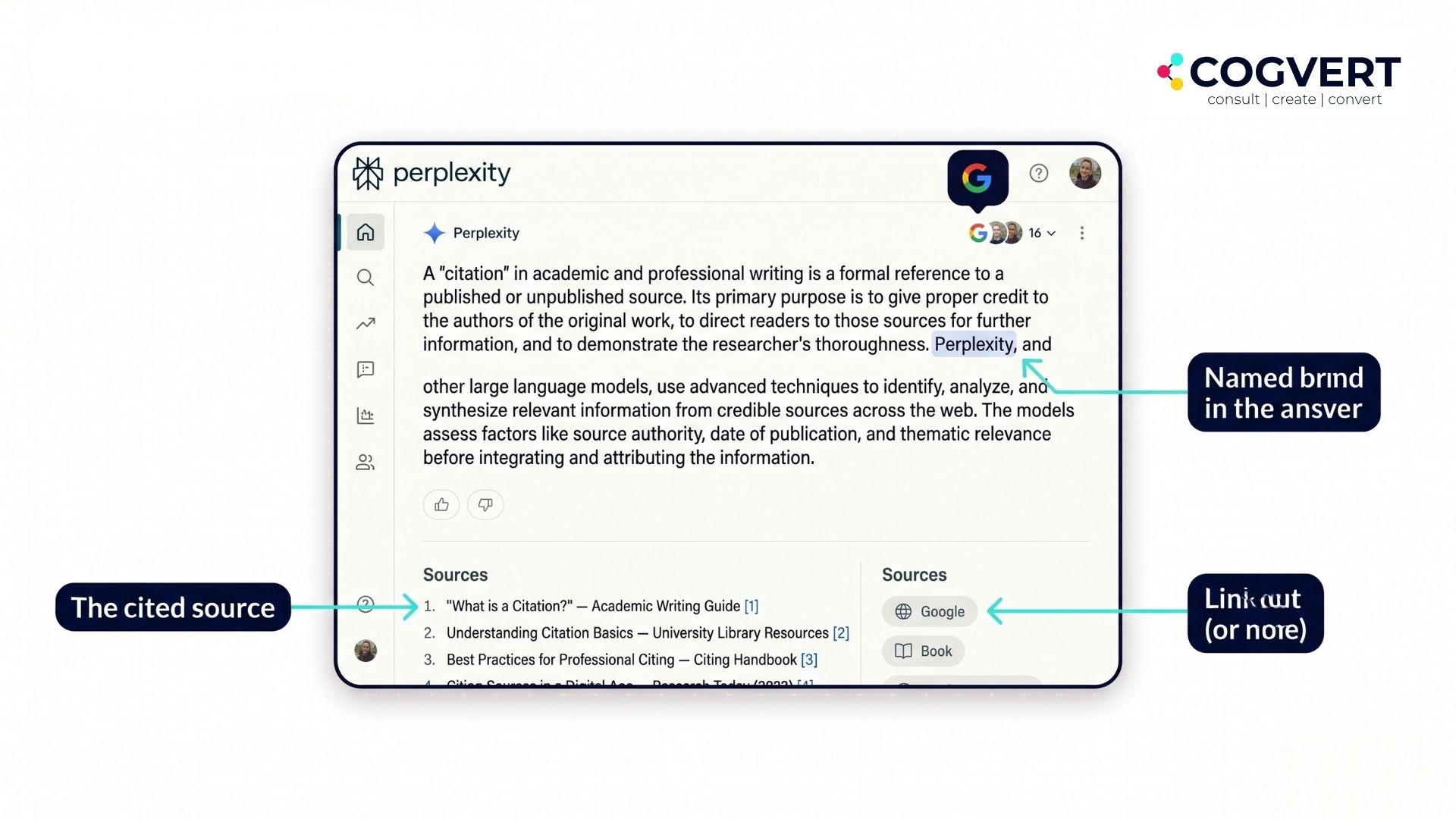
Extractability beats writing quality. Models favour content that answers a question in a compact, self-contained unit, a plain definition, a labelled list, a stat with its source sitting right next to it. A well-crafted 400-word paragraph that buries the answer somewhere in the middle regularly loses to a competitor’s blunt three-sentence answer, even when the longer piece is the better read for an actual human. Uncomfortable if you write for a living. Still true.
Corroboration beats originality. If three independent domains state a fact in roughly the same way, a model treats that fact as safe to cite, more so than one strong claim from a single authoritative domain. Odd side effect: the source that originally broke a story sometimes gets cited less than a later article that just repeated the finding, because the model’s checking for agreement across sources rather than rewarding whoever said it first.
Structured data still matters, just for a different reason. Schema markup like FAQPage, HowTo, Article, and Organization doesn’t force a citation the way it can trigger a rich result in classic search. What it does is make life easier for retrieval crawlers, things like GPTBot, Google Extended, PerplexityBot, ClaudeBot, trying to parse entity relationships on a page. Clean parsing improves the odds a page even makes it into a retrieval index in the first place. No retrieval, no citation, regardless of how well-written the page is.
Freshness carries more weight here than in classic ranking. For anything time-sensitive, pricing, stats, “best of” lists, AI engines lean towards recently updated pages, sometimes even over older pages with much stronger backlink profiles. Makes sense when you think about it: a single AI answer doesn’t hand someone ten blue links to sort through and judge for themselves. The model hedges towards whatever’s freshest because it’s committing to one answer, not a list of options.
Nothing is guaranteed. AI citation behaviour is probabilistic. It shifts across query phrasing, across sessions, across model updates. What you can actually influence is the probability of getting cited, through consistent structure, not a fixed placement the way a stable keyword ranking can hold for months at a stretch.
The Zero-Click Problem
A lot of AI citations never turn into an actual website visit. People take the synthesised answer and move on. They never click through. That changes what the metric is really worth; it sits closer to brand visibility, being the name someone remembers hearing, than to referral traffic. Judging AI citation performance by classic click-through benchmarks sets the wrong bar from the start.
Where Experience and Trust Fit In
The idea of experience, expertise, authoritativeness, and trust (E-E-A-T), the concept Google itself uses in its search quality guidance, maps onto AI citation behaviour too, just not identically. Models seem to weight content more heavily when it shows clear first-hand experience: named individuals with real credentials, specific numbers instead of vague claims, a visible publication or update date. Generic, unattributed content, even when it’s factually solid, is easy for a model to treat as interchangeable with some competing page. That lowers its odds of being the one actually named in an answer.
Where the Two Layers Converge
Local citation consistency is becoming an input to AI trust too, not just map pack ranking. Ask an AI system which orthodontist is best rated nearby, or whether a business is open on a given day, and increasingly it’s cross-referencing structured local data: Google Business Profile records, aggregator feeds, review platforms. Same data pool that’s been powering the map pack for over a decade.
A business with messy, inconsistent NAP data isn’t just weaker for map pack ranking anymore. It’s a less confidently resolved entity for every AI system pulling from that same structured local graph. Clean Google Business Profile data, correct Organization and LocalBusiness schema, a solid core of 15-20 high-trust directory citations: none of that is a local-SEO-only concern anymore. It’s identity infrastructure, full stop, for how every discovery system, not just Google, figures out who a business actually is.
Building a Strategy That Covers Both Layers
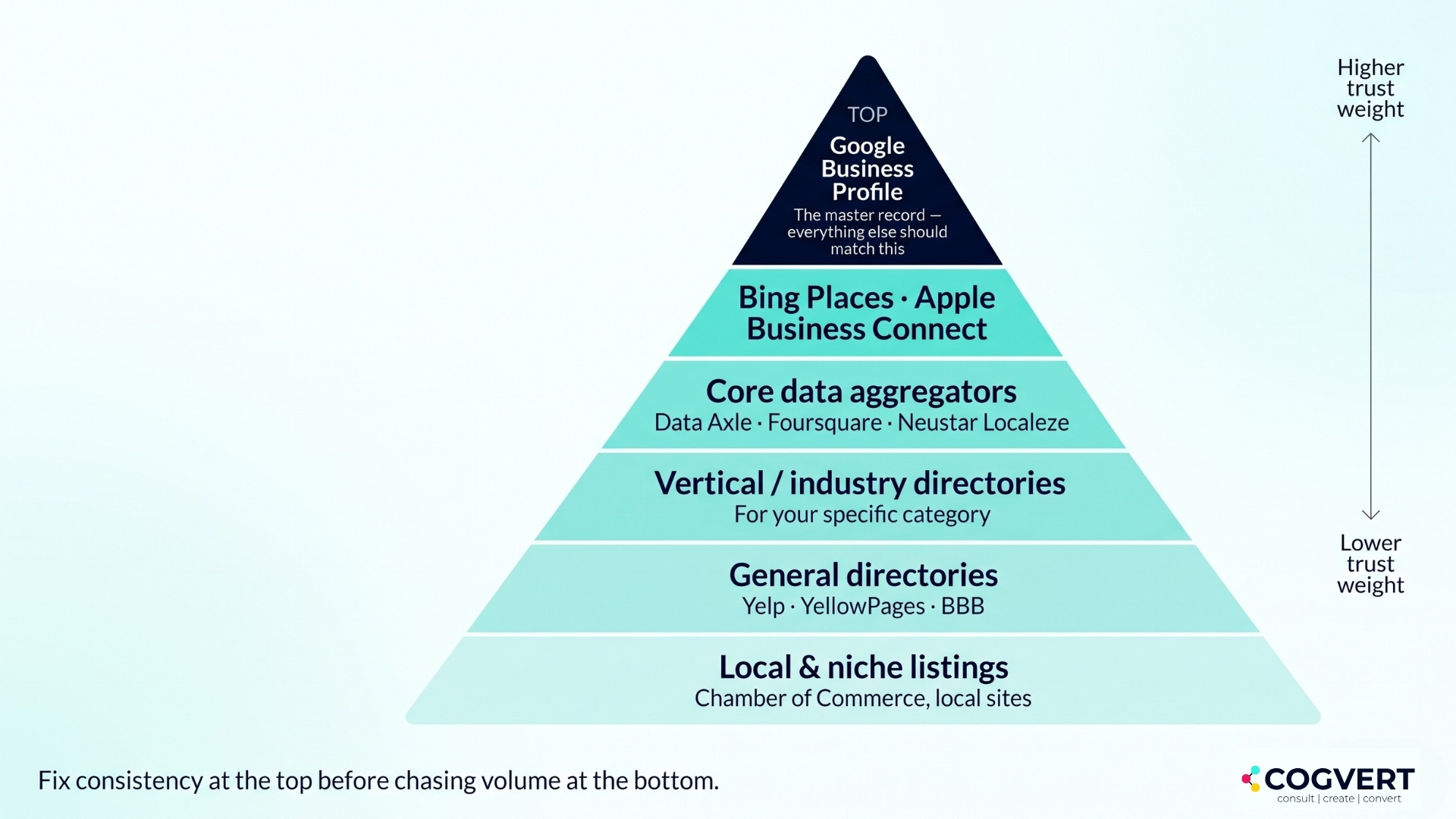
- Audit before adding anything new: Search combinations of business name and phone number in quotes, or use a dedicated tool, and see what already exists. Look for name variations, outdated addresses left over from a move, disconnected phone numbers, duplicate listings from an old rebrand or ownership change. Fix what’s already there before piling on more. Volume stacked on top of an inconsistent base just compounds the problem.
- Prioritise by trust weight, not raw count: Based on what consistently correlates with real ranking movement across audits, roughly this order: Google Business Profile first, treated as the master record everything else should match. Bing Places and Apple Business Connect next. Then the core aggregators, Data Axle, Foursquare, Neustar Localeze. Then industry-specific directories for the actual vertical. Then general directories like Yelp, YellowPages, BBB. Then local and niche listings, Chamber of Commerce and the like. Chasing volume at the bottom of that list while ignoring inconsistency at the top is probably the single most common wasted effort in agency work.
- Earn unstructured citations on purpose. Pitch local journalists. Aim for “best of the city” roundups. Sponsor a local event that naturally generates coverage afterward. Get listed in relevant industry association directories. This does double duty: strengthens classic citation trust, and it’s exactly the kind of independently written, corroborating content AI systems lean on when deciding what to cite. If you’d rather hand this off, a dedicated local SEO citation building service handles audit, aggregator submission and cleanup end to end.
- Structure content for extraction: For actual site content, not directory listings, write for retrieval as much as narrative flow. Answer the core question of a section in the first two or three sentences before adding nuance. State definitions directly instead of building up to them. Attach specific numbers to named sources when citing data. Break comparisons or processes into labeled lists or tables rather than leaving a model to dig structure out of dense prose. Keep FAQ sections tied to real queries people actually type, marked up with FAQPage schema.
- Track the two channels separately: Local map pack position and NAP consistency are one workstream, tracked with tools built for that. AI citation presence, whether a brand or page shows up in AI Overviews, Perplexity, or ChatGPT answers for target queries, is a separate workstream entirely, tracked through visibility tools or careful manual sampling. They move on different timelines and respond to different levers. Blend them into one metric and you lose sight of which lever actually did the work.
How to audit SEO citations (checker, report, audit tools)
A local SEO citation tool or citation checker — Whitespark, Moz Local or BrightLocal — pulls every listing so you can run a citation report against your master NAP record.
A proper audit follows roughly the same sequence every time. Pull every known listing using a tool like Whitespark, Moz Local, or BrightLocal, backed up by manual search checks. Compare each one against the current, correct NAP record, the one treated as the master. Flag mismatches by severity. A wrong phone number matters more than an inconsistent suite-number format, since it breaks the customer experience on top of the algorithmic issue.
Fix the aggregator layer first, since corrections there propagate downstream on their own. Move to top-tier structured listings next. Handle unstructured mentions, an outdated address sitting in some old news article, through direct outreach, since there’s no dashboard for those.
Re-audit on a schedule, at least once a year. Aggregator re-syncs, moves, and rebrands quietly reintroduce inconsistency over time, even for a business that hasn’t touched anything on purpose.
Measuring Performance
For the local layer: track map pack position for core queries, citation consistency across a defined set of listings, and Google Business Profile metrics like call clicks, direction requests, website visits.
For the AI layer: track citation frequency across a fixed set of representative prompts, sampled on a regular schedule, since single snapshots are too noisy to mean much on their own. Track which pages actually get named as sources, since that tells you which content format is working. Track branded search volume over time too, as a rough proxy for the visibility generated by zero-click AI answers, since referral traffic alone will understate the real impact of this channel.
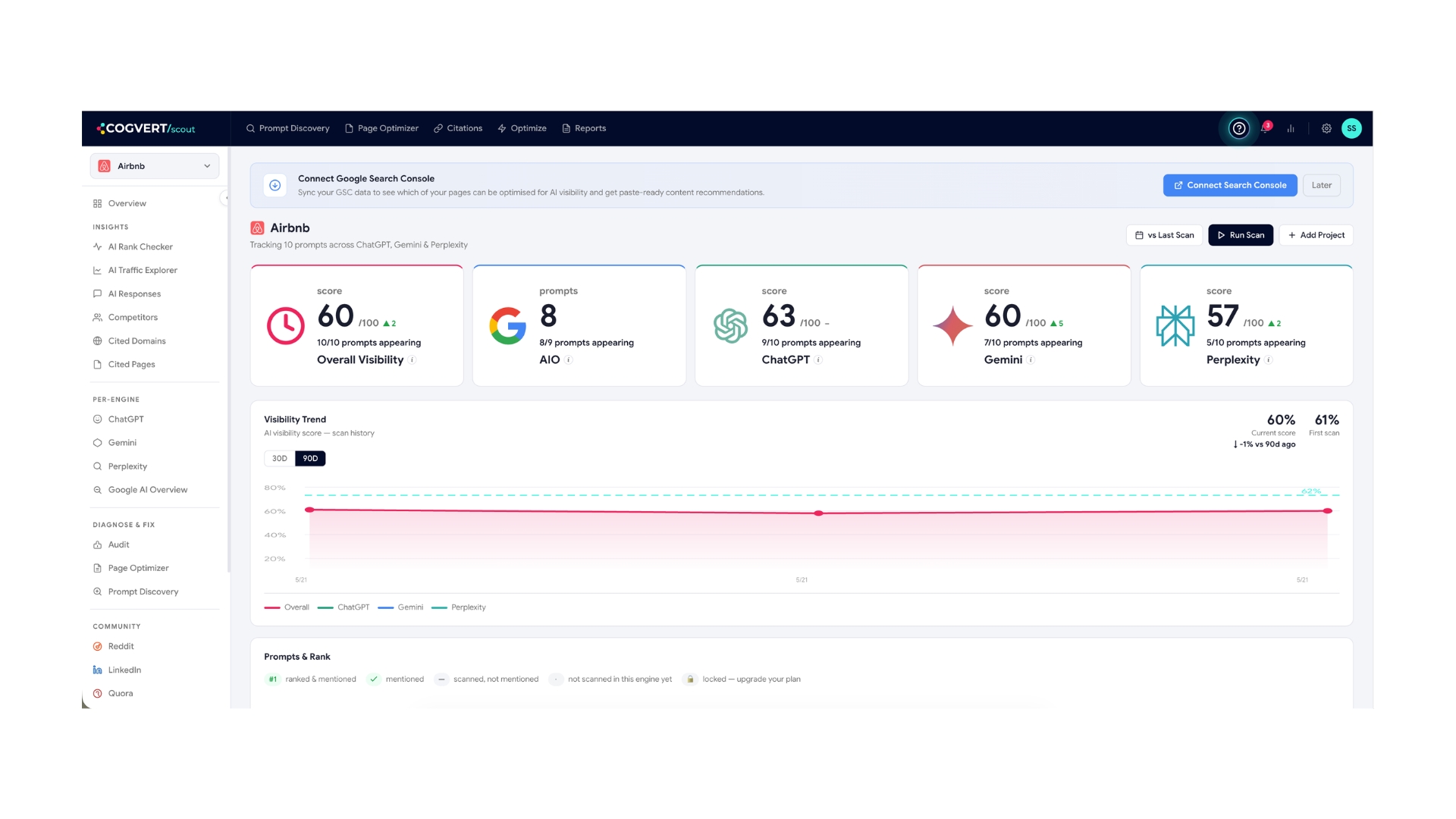
Cogvert Scout tracks these AI-layer signals for you — AI Visibility Score, brand mentions, Share of Voice, citations and sentiment across ChatGPT, Gemini, Perplexity and Google AI Overviews — so you can sample them on a schedule instead of by hand. Scout doubles as a citation analysis tool for AI SEO, tracking AI citation frequency and which pages get named as sources across ChatGPT, Gemini, Perplexity and Google AI Overviews. See Cogvert Scout.
Common Mistakes
- Treating citation work as a one-time project: Businesses move, rebrand, change phone systems, and aggregators occasionally re-sync incorrectly on their own. Consistency decays over 12-18 months without upkeep, even for a business that hasn’t changed anything.
- Chasing raw citation count as a vanity metric: 300 low-quality, inconsistently formatted directory listings will lose to 40 clean, high-trust ones. This has played out the same way in split audits more than once.
- Judging an AI citation like a website click: Plenty of people accept the synthesised answer and never visit the source, so this channel needs to be judged on visibility, not click-through rate.
- Ignoring NAP accuracy on the business’s own site: Sounds too obvious to mention, and yet inconsistent NAP between a footer, a contact page, and the schema markup shows up in nearly every audit anyway.
- Believing AI placement can be bought or locked in: Nobody can guarantee a fixed AI citation the way paid search guarantees ad placement. Anyone selling that promise is selling something that doesn’t exist.
Frequently Asked Questions
Does a citation need a link to count for local SEO?
No. A plain-text mention of name, address, and phone counts, link or no link.
How many citations does a business actually need?
No universal number here. A clean, consistent set of 15-40 high-trust citations, matched to the right category and location, tends to beat an inflated count built from low-quality sources.
Is local citation building still worth doing given AI search?
Yes, arguably more than before. The same structured local data now feeds both the map pack and the AI answer engines pulling from that shared graph.
What’s the fastest way to improve local rank through citations?
In most audits, fixing existing NAP inconsistency produces a faster, bigger jump than adding new volume, especially for a business old enough to have accumulated legacy noise.
Can a small business earn AI citations without a big content team?
Yes. AI citation probability responds more to structure and extractability than to sheer volume or team size. A handful of clearly structured, well-sourced pages targeting specific questions can beat a much larger pile of loosely structured content.
Does citation drift affect traditional SEO?
Yes. Citation drift — when NAP details fall out of sync as a business moves, rebrands or changes phone systems — weakens entity confidence and can suppress local rankings. It typically creeps back within 12–18 months without upkeep, which is why citations need periodic re-auditing rather than a one-time fix.
How does an SEO company generate a citation?
An SEO company generates a citation by submitting consistent NAP data to structured sources — Google Business Profile, Bing Places, Apple Business Connect and core aggregators like Data Axle and Foursquare — and by earning unstructured mentions through local PR, “best of” roundups and industry directories. The aggregator layer is handled first, since corrections there propagate downstream automatically.
What is citation flow in SEO — is it the same as a citation?
No. Citation Flow is a link-based metric from Majestic that scores how many links point to a URL. It has nothing to do with a NAP citation or an AI-search citation. If you’re researching business listings or AI mentions, citation flow is a separate concept and a separate tool.
The Bottom Line
Strip away the two eras of the word and citation comes down to one idea: verifiable, consistent entity data, wherever it lives on the web, is the raw material every discovery system uses to decide whether a business, or a piece of content, is real and trustworthy enough to surface. The businesses treating this as ongoing data hygiene, rather than a one-time directory submission sprint, are the ones still showing up, in the map pack and in AI-generated answers alike, heading through 2026 and past it.
Put this into practice with Cogvert
Cogvert is an AI-first digital marketing agency specialising in generative engine optimisation (GEO), AI SEO and content. Book a free consultation about our Local SEO and GEO services, or start free with Cogvert Scout to see where your brand shows up across AI answers today.