Search
Locations

Journalism, AI & the Future of Digital Visibility: Report

In 2026, users are no longer “searching” in the traditional sense. They are asking questions—to AI systems, conversational interfaces, agentic browsers, and recommendation engines. These
Organic Search
AI SEO
Agentic AI
Content Overview

Author

Picture of Sandeep Sharma

Sandeep Sharma

Founder, Cogvert Marketing Pvt Ltd
An AI-first digital marketing agency specializing in Generative Engine Optimization (GEO), AI SEO, AEO, and content strategy.

Connect on Linkedin
Content Overview

Beyond Search: How AI Answer Engines Are Redefining News, Content, and Visibility

The news industry stands at another critical juncture. Following years of disruption driven by social media platforms, the rapid ascent of Generative AI represents the latest technological shift poised to profoundly reshape journalism. This evolution is not merely an incremental change but a fundamental rewiring of how information is accessed, synthesized, and consumed. For a sector already navigating declining engagement and low public trust, the emergence of AI introduces both an existential challenge and a powerful catalyst for strategic transformation.

This white paper provides a data-driven, strategic framework for senior editorial and product leaders to adapt their content strategies for this new reality. Its objective is to move beyond speculation and offer an evidence-based analysis of the threats posed by AI-driven “answer engines.” More importantly, it outlines a clear, actionable path toward building a more resilient and valuable content portfolio—one that can thrive in an ecosystem where generic information has become a commodity.

The following analysis will first quantify the scale of the impending traffic disruption and identify the mechanics behind it. We will then examine which specific content categories are most vulnerable to commoditization by AI. Finally, we will detail a recommended strategic pivot, focusing on the types of distinctive, human-centric journalism and the defensible content formats that will define the future of successful news organizations.


How can brands stay visible when AI answers replace search clicks?

To remain discoverable, brands must move beyond traffic-led SEO and design for AI-native discovery. This means building clear entity authority, trusted citations, and contextual relevance so AI systems can confidently reference your brand when generating answers—without relying on traditional rankings alone.

"The future does not belong to the organizations that attempt to compete with machines at their own game; it belongs to those that focus relentlessly on producing the indispensable journalism that only humans can create."

1. The Tectonic Shift: From Search Engines to Answer Engines

The transition from traditional search engines to AI-powered “answer engines” represents the most significant threat to publisher business models in recent years. This paradigm shift fundamentally alters the long-standing relationship between users, information platforms, and original content creators. For over a decade, referral traffic from search has been a cornerstone of digital publishing strategies, driving audience acquisition and advertising revenue. The rise of answer engines, which prioritize providing direct, synthesized responses over linking to source material, jeopardizes this critical flow of traffic and revenue.

Quantifying the Threat

This is not a distant concern; the impact is already being felt, and industry leaders are bracing for a substantial downturn. A survey of 280 news executives reveals a stark consensus: publishers expect traffic from search engines to decline by an average of 43% over the next three years.


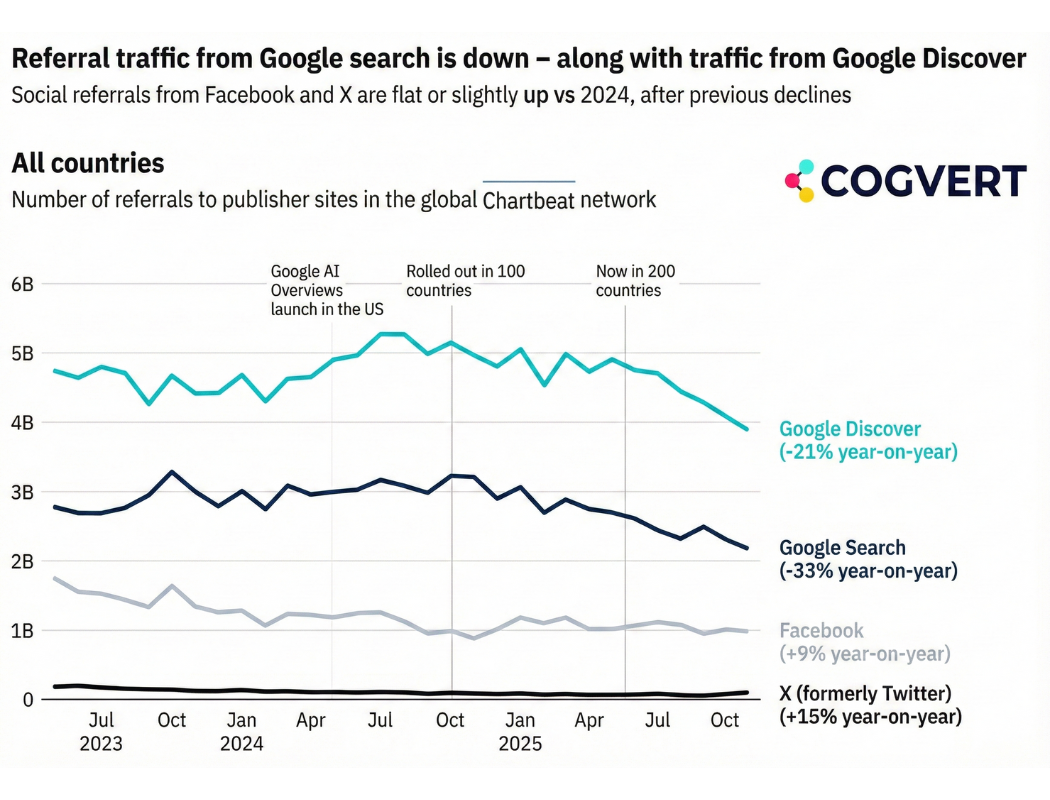
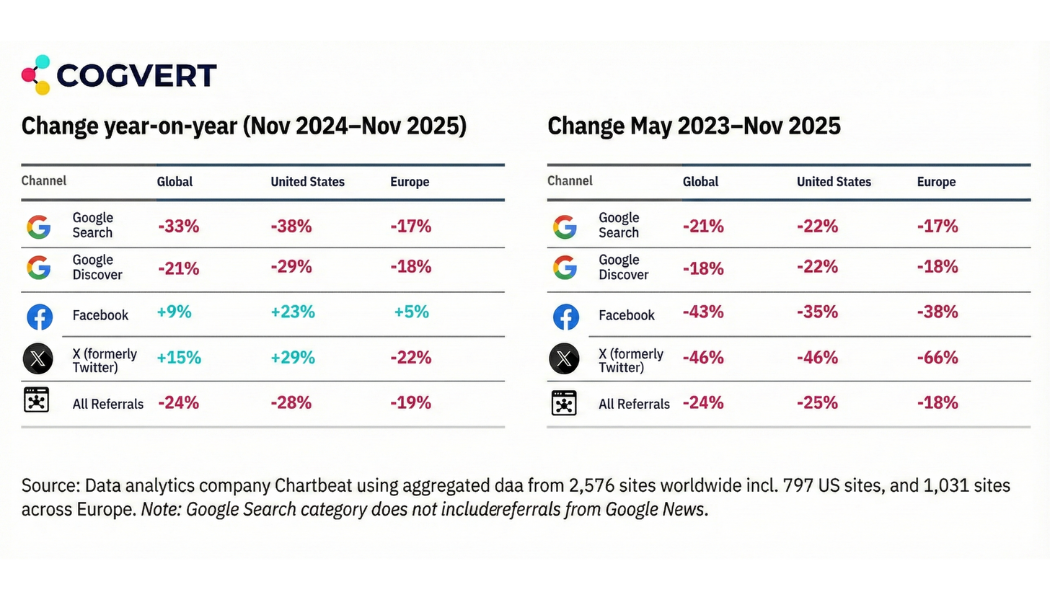
Data from the analytics provider Chartbeat confirms this trend is already underway. However, the exact causes are multifaceted.

  • Globally, Google Search referrals to over 2,500 news sites were down by 33% between November 2024 and November 2025, but it is not clear how much of this is down to AI overviews.
  • The decline was even more pronounced in the United States, which saw a 38% drop in the same period.
    This new disruption compounds the challenges from previous platform shifts. It follows dramatic declines in social referrals over the past three years from key platforms like Facebook (-43%) and X, formerly Twitter (-46%)
 

The Mechanism of Traffic Loss

The mechanics behind this traffic erosion are straightforward. Features like Google’s AI Overviews intercept user queries by surfacing summarized answers directly within the search results page or in a dedicated chat window. This creates a surge in “Zero-click searches,” where the user’s informational need is met without them ever having to click through to a publisher’s website. As these AI-driven features become more integrated and sophisticated, the incentive for users to visit original source articles for general information will diminish significantly.

However, the impact of this shift is not uniform across all types of journalism. The vulnerability of a news organization is directly tied to the type of content it produces, making a strategic content audit more critical than ever.

2. The Commoditization Crisis: Identifying At-Risk Content

In an environment where AI can instantly synthesize and repackage vast amounts of information, undifferentiated content becomes a liability. Understanding which content categories are most vulnerable is a strategic imperative. Continuing to invest resources in journalism that an AI can replicate more efficiently is a losing proposition, as this content will struggle to attract direct audiences, build loyalty, or justify a subscription. It is, in effect, a commodity.

Vulnerable Content Categories

Survey data from news leaders reveals a clear strategic retreat from content types that are easily summarized or answered by AI. The following categories are being actively de-emphasized, as indicated by the net score representing the difference between leaders planning to focus more versus less on them:

  • Service Journalism (-42 net score): This category includes utility-focused content such as weather forecasts, TV guides, product reviews, and other “how-to” information. AI models are exceptionally effective at aggregating this data and providing direct answers, rendering publisher-hosted versions redundant.
  • General News (-38 net score): Even the reporting of general news events is at high risk. AI chatbots and aggregators can quickly scrape and synthesize breaking news from multiple sources, presenting users with a concise summary that often satisfies their immediate curiosity.
  • Evergreen Content (-32 net score): Durable content, such as travel guides or definitional articles, is particularly vulnerable. AI can easily parse this structured information and repackage it, stripping the original publisher of the long-tail traffic this content once reliably generated.

The Strategic Implication

The core insight for news leaders is clear: continuing to allocate significant editorial and financial resources to these at-risk areas represents a substantial business risk. These content types are the least defensible against AI and are unlikely to serve as effective drivers of traffic, audience loyalty, or revenue in the coming years.

This realization forces a critical question for every news organization: If these traditional pillars of content strategy are becoming commoditized, where should we redirect our resources to build a durable, defensible competitive advantage?

43%
declined

in search traffic over the next 3 years.

280+

News executives surveyed

3. The Strategic Imperative:Pivoting to Distinctive, Human-Centric Journalism

The primary strategic response to the threat of AI commoditization is a decisive pivot toward distinctive, high-value journalism that machines cannot replicate. As Taneth Evans, Head of Digital at the Wall Street Journal, succinctly puts it, “Journalism’s best response is to double down on the things that make us valuable and unique.” This means shifting focus from what can be easily aggregated to what must be originally created.

High-Value Content Pillars

An analysis of where publishers are increasing their strategic focus reveals a clear pattern. They are investing in journalism that is fundamentally human, analytical, and proprietary.

Content Pillar Strategic Value in the AI Era
Original Investigations & On-the-Ground Reporting (+91) This content is inherently defensible as it creates new, proprietary information that AI cannot generate on its own.
It relies on unique access, deep sourcing, physical presence, and methodical discovery—qualities that are exclusively human.
Contextual Analysis & Explanation (+82) In a world flooded with raw information, this content provides the crucial “why” behind the news.
It offers expert framing, deep insight, and nuanced interpretation that goes far beyond an AI’s ability to merely summarize facts.
Community Building (Live Journalism/Events) (+76) This strategy creates a defensible moat against AI by building direct audience relationships and offering unique, in-person
experiences that cannot be digitized, scraped, or summarized. It transforms the publisher from a content provider into a community hub.
Human Stories (+72) This content connects with audiences on an emotional level. Narrative, empathy, and the capturing of unique personal
perspectives are powerful differentiators that AI struggles to replicate with any authenticity.
Fact-Checking & Verification (+63) As the volume of “AI slop” and sophisticated deep-fakes grows, the role of a trusted, human-led verification process becomes
a premium, high-value service. It establishes the publisher as an essential arbiter of truth.
Opinion & Commentary (+55) Distinctive voices, expert commentary, and provocative arguments build a direct, personal relationship with an audience.
By definition, this content is non-commoditizable and fosters the kind of loyalty that drives subscriptions.

The Core Argument

The strategic thread connecting these pillars is their immunity to simple summarization. As Martin Schori, Head of AI at Aftonbladet, notes, the answer is to “focus on journalism that can’t easily be summarised in the three bullet points.” The value no longer lies in being the first to report a fact, but in being the only one who can uncover it, explain it, or frame it in a compelling, human way.

However, what a newsroom covers is only part of the strategy. How that distinctive content is packaged and delivered is equally critical for success in the AI era.

4. A Multi-Format Future: Investing Beyond the Article

Competing effectively in the age of AI requires a strategic evolution of content formats. While text-based articles will remain important, their susceptibility to being scraped, summarized, and repackaged by AI models necessitates a diversification into formats that are more defensible. The goal is to create immersive experiences that encourage deeper, more habitual engagement and are less easily cannibalized by answer engines.

The Decisive Shift to Video and Audio

The statistical evidence for this format pivot is overwhelming. When asked how they plan to compete with AI, news leaders showed a powerful consensus:

  • Over three-quarters of survey respondents (79%) believe it is important to invest more in video.
  • A strong majority (71%) are also looking to expand their investment in audio formats like podcasts.

The Rationale for a Format Pivot

The strategic logic behind this shift is rooted in the inherent limitations of current AI technology. As Christof Zimmer, the incoming CEO at Der Spiegel, explains, “If creating text no longer costs anything, that brings brutal new competition.” Text is fluid and easily deconstructed by algorithms. By contrast, the theory is that well-structured, linear video and audio are more likely to be consumed as a whole and linked to by platforms, rather than being scraped and summarized. These formats create a more complete, self-contained experience that is more difficult for an AI to distill into a few bullet points without losing the essential context, tone, and narrative that makes the content valuable in the first place.

The most resilient news organizations will be those that align their distinctive content pillars with these engaging and defensible formats, creating a powerful synergy that builds both brand value and audience loyalty.

5. Conclusion: Forging a Resilient Path Forward in the AI Era

The modern news organization faces a dual challenge of unprecedented scale: the erosion of referral traffic from AI-driven answer engines and the simultaneous commoditization of generic news content. The old models of relying on search optimization for broad, undifferentiated articles are rapidly becoming obsolete. Continuing down this path is not a strategy for growth, but a blueprint for decline.

However, this disruption also brings clarity. The strategic solution requires a disciplined, two-pronged approach that leverages the core strengths of journalism:

  1. A strategic de-prioritization of commoditizable content. This means consciously reducing investment in areas like service journalism, evergreen guides, and general news that AI can replicate more efficiently.
  2. A decisive pivot and increased investment in distinctive, human-centric journalism. This involves doubling down on original investigations, deep analysis, compelling human stories, and community-building events—the very content that is inherently defensible—and delivering it through engaging formats like video and audio that resist easy summarization.
 
While Generative AI presents an existential threat to legacy content strategies, it also illuminates the enduring and irreplaceable value of professional journalism. In an information ecosystem increasingly filled with automated, low-quality content, the demand for unique, high-quality, and trustworthy reporting will only grow. 

 
Consult with Cogvert Expert.

Get personalized guidance and future-proofed solutions directly from our architectural team.

91-9650355564

Cogvert builds comprehensive, AI-powered SEO strategies that elevate brand authority, accelerate organic growth, and deliver sustained increases in qualified traffic, leads, and revenue.
Related Topics
Let’s talk about what Cogvert can do for your business.

Secure your competitive advantage with personalized architectural guidance and future-proofed growth solutions directly from our innovation team.

    Web Design
    Development
    SEO

    Organic Search

    SEO Growth (Search Engine Optimization)


    SEO growth increases visibility, drives organic traffic, and boosts business performance.

    SEO Growth (Search Engine Optimization)


    SEO growth increases visibility, drives organic traffic, and boosts business performance.

    Organic Search

    SEO Growth (Search Engine Optimization)


    SEO growth increases visibility, drives organic traffic, and boosts business performance.

    SEO Growth (Search Engine Optimization)


    SEO growth increases visibility, drives organic traffic, and boosts business performance.