

Newsweek’s organic search traffic did not erode gradually through 2025 — it peaked at an estimated 10.16 million monthly visits in November 2025, then collapsed to roughly 1.53 million by June 2026 — an ~85% loss from peak and a ~70% year-over-year decline (May 2025 to May 2026: minus 67%). The framing of being down since 2025 is directionally right, but the precise picture matters: the damage is concentrated in a sharp, sustained fall that began with the December 2025 core update and deepened through the March and May 2026 core updates.
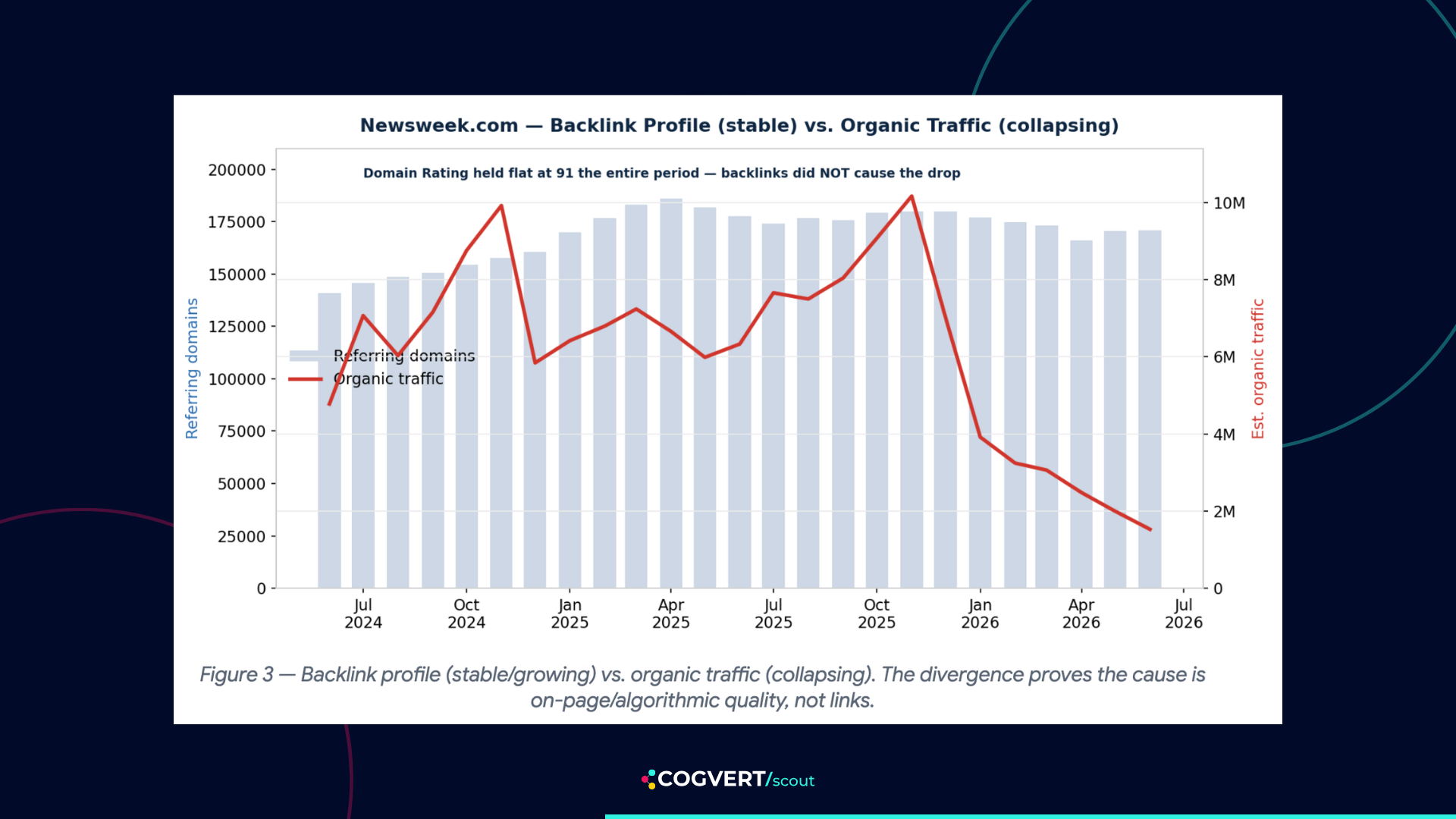
The decline is algorithmic and content-driven, not a link or authority problem. Domain Rating held flat at 91 the entire period and referring domains actually grew (about 158K to 171K), so backlinks and brand authority did not cause this. The losses are overwhelmingly in commodity, high-velocity content — live updates, weather alerts, war live-blogs, outage trackers — the exact content layer that Google’s late-2025 and 2026 core updates and the continued expansion of AI Overviews devalued hardest.
Primary factors, in order of contribution: (1) over-reliance on commodity newsjacking, aggregation and weather content optimized for Top Stories, Google Discover and the long tail; (2) three consecutive core updates (Dec 2025, Mar 2026, May 2026) with no recovery window; (3) AI Overviews and SERP-feature expansion compressing click-through on informational queries; and (4) a site-quality reassessment visible as a mass long-tail de-ranking in Sept to Oct 2025 that preceded the traffic fall.
| Metric | Nov 2025 (Peak) | Jun 2026 | Change |
|---|---|---|---|
| Est. monthly organic visits | 10,164,382 | 1,525,802 | -85.0% |
| Est. monthly traffic value | $2.44M | $0.49M | -80.1% |
| Keywords ranking pos. 1–3 | 198,429 | 51,746 | -73.9% |
| Keywords ranking pos. 4–10 | 265,718 | 89,761 | -66.2% |
| Keywords ranking pos. 11+ | 757,754 | 67,228 | -91.1% |
| Domain Rating | 91 | 91 | No change |
| Referring domains | 179,988 | 170,929 | -5.0% |
Why ranking #1 on Google doesn't guarantee a single AI mention?
"If you're a brand-new company with no online presence, start with SEO fundamentals. Build your website, create foundational content, establish basic authority. You need a website worth referencing before AI models can reference it."
The traffic trajectory and Google-update timeline
The chart below plots Newsweek’s estimated monthly organic traffic from mid-2023 to June 2026, with Google core-update windows shaded. The story has three acts: a strong 2024-2025 build to an all-time high in November 2025, a cliff that opens with the December 2025 core update, and a stair-step decline through the 2026 updates.
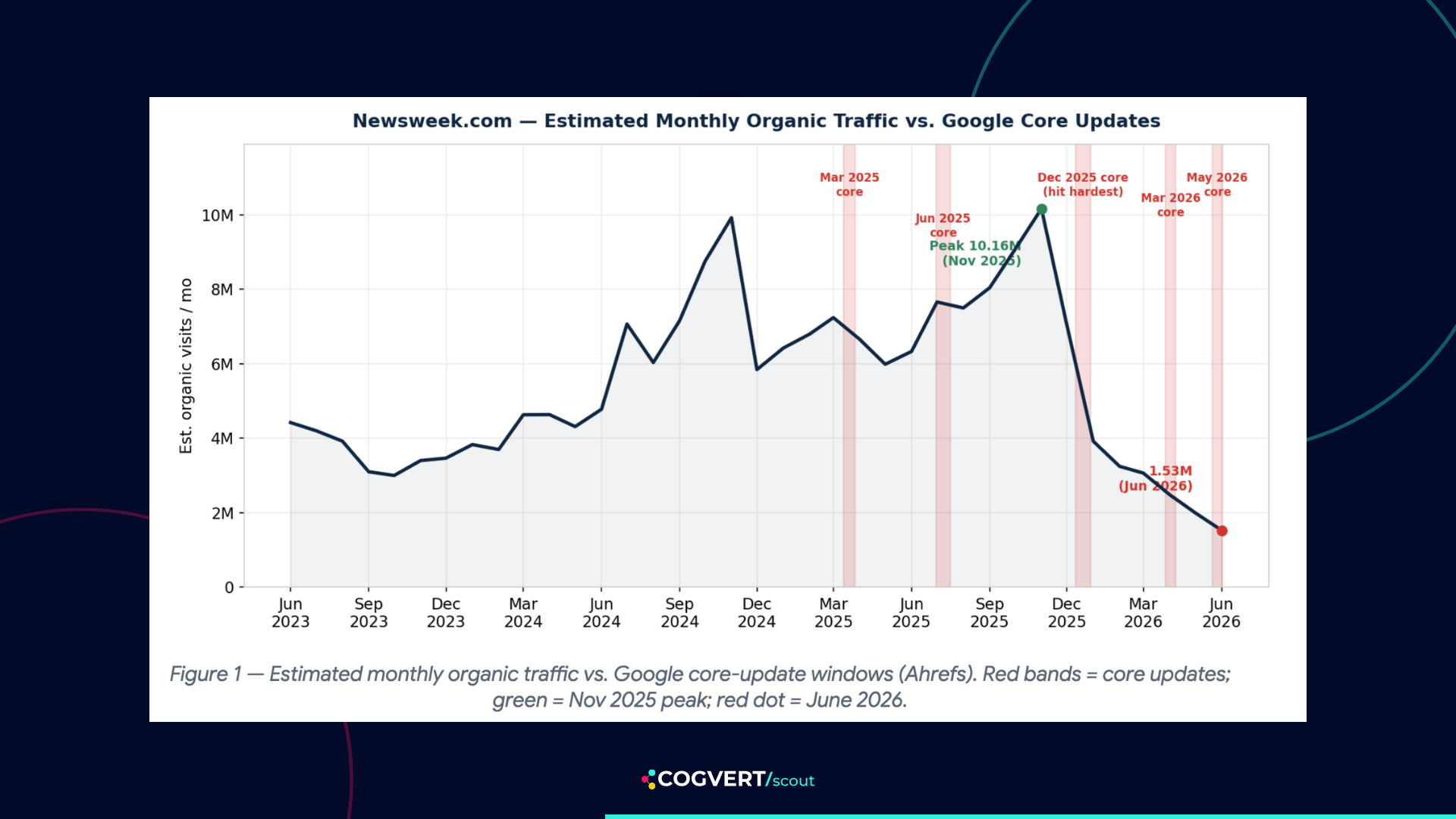
A crucial nuance: the early-2025 core updates did not hurt Newsweek. Through the March 2025 (Mar 13–27) and June 2025 (Jun 30–Jul 17) core updates, traffic kept climbing. Whatever changed in late 2025 is what broke the model — not a long-running slow decline.
Google core updates, 2025-2026, and their effect on Newsweek
| Update | Rollout | Industry Note | Effect on Newsweek |
|---|---|---|---|
| Mar 2025 core | Mar 13–27, 2025 | Broad quality update | Resilient — traffic continued rising |
| Jun 2025 core | Jun 30–Jul 17, 2025 | Broad quality update | Resilient — climbed to 7.7M by Jul |
| (Sep–Oct 2025) | Ongoing | SERP / index volatility | Long-tail footprint begins collapsing |
| Dec 2025 core | Dec 11–29, 2025 | Hit hardest of the year; ~66.8% of top-3 results shifted | Trigger of the collapse: 7.03M (Dec) to 3.92M (Jan), -44% MoM |
| Mar 2026 core | Mar 27–Apr 8, 2026 | Targeted mass-produced / AI content (reported ~71% drops) | Deepened decline: 3.06M (Mar) to 2.48M (Apr) |
| May 2026 core | May 21–Jun 2, 2026 | Felt larger than March; high volatility | Final leg down: 2.00M (May) to 1.53M (Jun) |
Table 2 — Core-update timeline correlated to Newsweek’s monthly traffic. Sources: Search Engine Land, Search Engine Roundtable, SE Ranking
What the rankings reveal: long tail first, then the head
Splitting Newsweek’s ranking keywords by position bucket exposes the mechanism. The long-tail footprint (positions 11+) collapsed first — from
about 5.38M keywords in August 2025 to about 1.41M in October and about 758K by November — before overall traffic fell. Traffic held up into
November only because the high-value top-3 and 4-10 positions were still intact (top-3 actually hit its own high of about 198K in Nov 2025). When the December 2025 core update finally hit those head positions, traffic fell off the cliff.
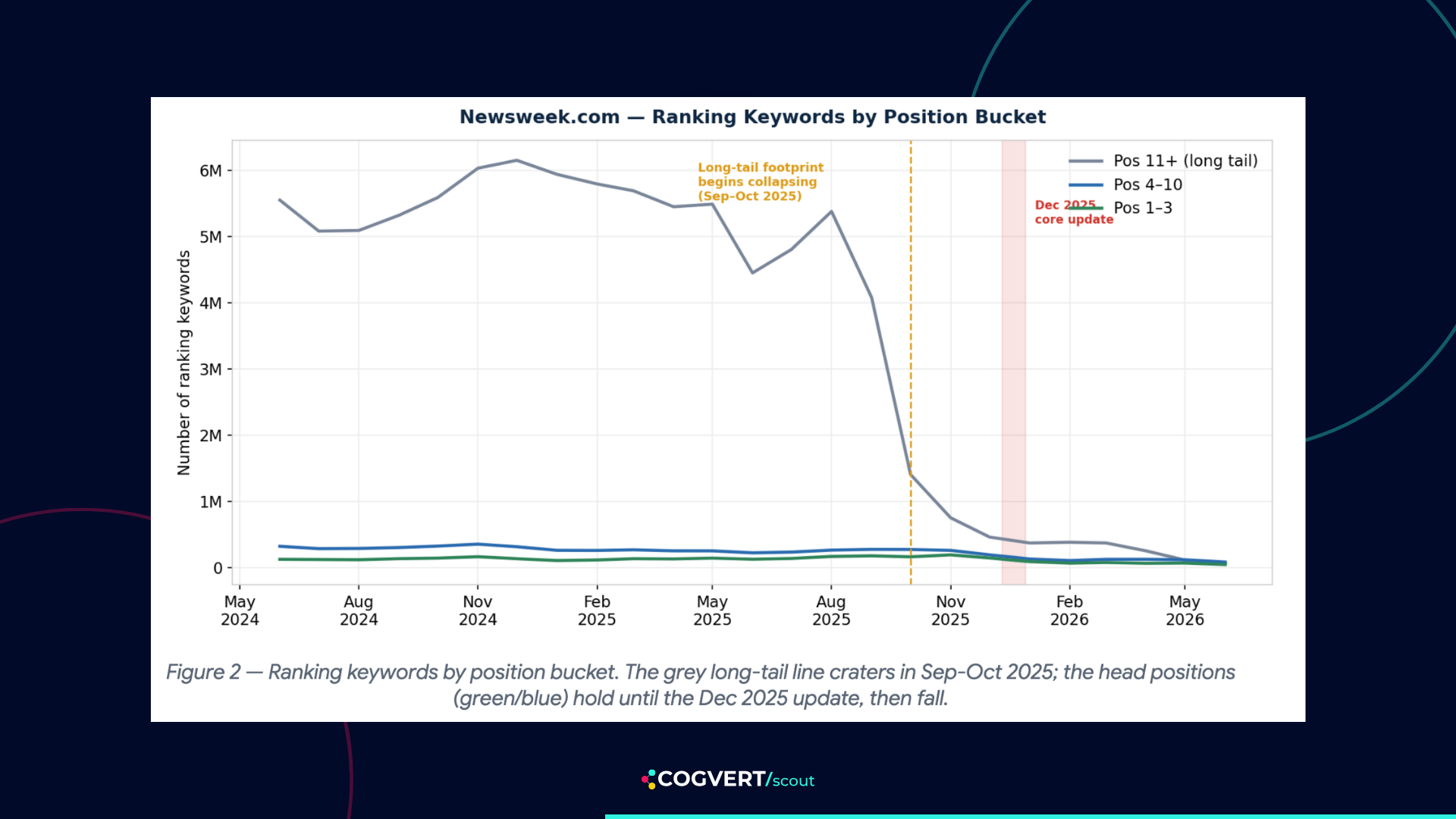
Interpretation: a roughly 90% wipe of the long tail ahead of any traffic loss is the signature of a site-quality reassessment and large-scale de-ranking of thin pages — Google deciding a large share of Newsweek’s URLs no longer merit indexing or competitive positions. The subsequent head-term losses across three core updates then converted that into the headline traffic decline.
Ruling out the usual suspects
It is not backlinks or lost authority. Domain Rating was a flat 91 from June 2024 through June 2026, and referring domains rose over the same window. If anything, Newsweek’s link profile strengthened while traffic collapsed — categorically ruling out a link-based or authority-loss explanation.
It is not a manual penalty, and not lost brand demand. The decline is a multi-month algorithmic stair-step aligned to named core updates, not an overnight drop to zero. And the homepage itself barely moved — an estimated 193.7K to 169.9K visits (-12%) — so people still actively search for Newsweek. The brand is intact; the commodity content around it is what Google stopped rewarding.
Diagnosis: which content collapsed
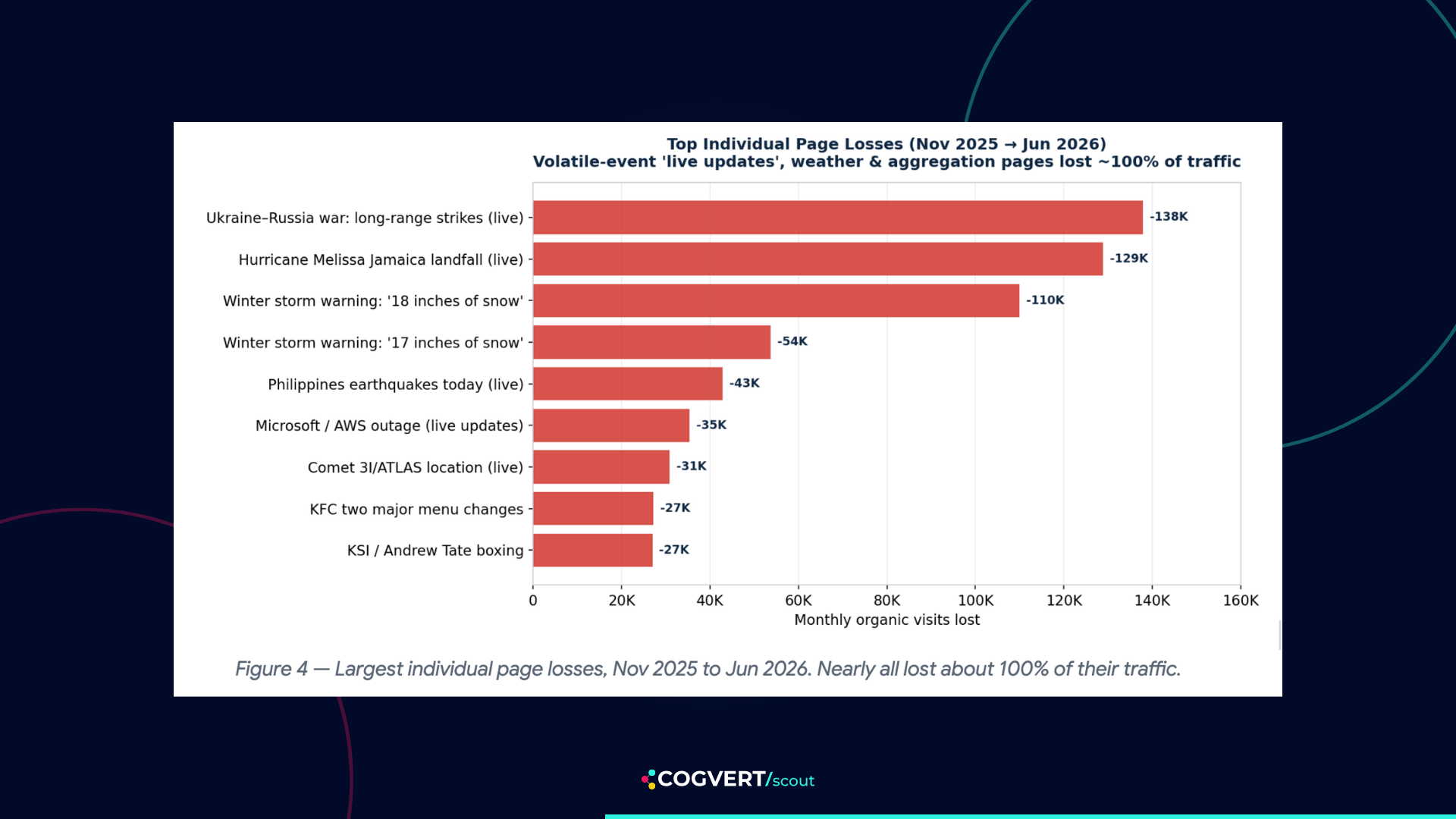
Comparing top pages between November 2025 and June 2026 isolates the casualties.
They are almost entirely volatile-event live updates, weather alerts, war live-blogs, outage trackers and quick-hit aggregation
— pages that pulled six-figure monthly traffic despite tiny core-keyword search volumes, because they were vacuuming up Top Stories placements,
Google Discover, and thousands of long-tail variations.
94% of CMOs
plan to increase GEO/AEO investment in 2026
40% visibility
improvement achieved with GEO-specific techniques vs traditional SEO alone
Representative casualties
| Page (Topic) | Nov 2025 | Jun 2026 | Core KW Volume |
|---|---|---|---|
| Ukraine-Russia war: long-range strikes (live) | 137,917 | 8 | 1,900 |
| Hurricane Melissa Jamaica landfall (live) | 128,907 | 0 | 20 |
| Winter storm warning: 18 inches of snow | 110,014 | 1 | 30 |
| Winter storm warning: 17 inches of snow | 53,737 | 0 | 10 |
| Philippines earthquakes today (live) | 42,878 | 52 | 900 |
| Microsoft / AWS outage (live updates) | 35,392 | 17 | 7,400 |
| Comet 3I/ATLAS location (live) | 30,870 | 11 | 4,700 |
| Homepage (newsweek.com) | 193,684 | 169,883 | 125,000 |
The pattern is unambiguous: the traffic that vanished was the most algorithmically fragile kind — high-volume, low-differentiation coverage of fast-moving events where dozens of outlets publish near-identical updates, and where AI Overviews now answer the query directly. None of it depended on Newsweek’s brand or reporting depth, which is exactly why Google’s quality systems could reallocate it.
Contributing context: content model and AI
Newsweek’s publicly documented strategy lines up with the data. Newsweek formalized an AI-in-the-newsroom policy in 2023 and, per the Nieman Journalism Lab, made generative AI a fixture of its newsroom in 2024 to increase output. Trade reporting (Digiday) describes Newsweek explicitly trying to beat the AI squeeze by building revenue beyond traffic — an implicit acknowledgement that its high-volume, search-dependent traffic model was structurally exposed.
Two structural forces compound this:
- AI Overviews and zero-click. Through 2025–2026 Google expanded AI-generated answers above organic results, disproportionately absorbing the informational, what-is-happening-now queries that Newsweek’s live and aggregation pages targeted — compressing click-through even on rankings that survived.
- Core-update quality bar. The Dec 2025 to May 2026 updates explicitly elevated originality, first-hand experience and brand-level trust while devaluing mass-produced and derivative content. Third-party analyses of the March 2026 update reported about 71% traffic cuts for mass-produced/AI content and gains for sites using original data — the opposite ends of the spectrum Newsweek’s two content types sit on.
Conclusions: what caused the drop
Synthesizing the quantitative and qualitative evidence, the ~70% YoY (~85% peak-to-trough) decline is best explained by the following, in order of contribution:
- Over-exposure to commodity, high-velocity content (primary).
Live blogs, weather alerts, outage/event trackers and aggregation built on Top Stories, Discover and the long tail — the precise layer the 2025–2026 core updates and AI Overviews devalued. This is where roughly 90% of the lost traffic sat. - Three sequential core updates with no recovery window (Dec 2025, Mar 2026, May 2026).
Each compounded the last; the December update was the trigger, the spring updates prevented any rebound. - AI Overviews and SERP-feature expansion (zero-click).
Structural click-through compression on the informational queries Newsweek depended on. - Site-quality reassessment / long-tail de-ranking (Sep–Oct 2025).
An early ~90% long-tail wipe signalling Google judged a large share of pages as thin — consistent with scaled, AI-assisted production.
Explicitly NOT responsible: Backlinks or authority loss (DR 91 stable, referring domains up), brand-demand loss (homepage steady), or a manual penalty (gradual, update-aligned algorithmic pattern).