

We have been observing a quiet shift that is happening over the last two years and anyone can miss that in a blink.
These days’ people stopped searching Google search bars and started asking. They are just asking ChatGPT and get a direct answer without scrolling, comparing and figuring out which result is actually useful to them. They trust what AI is trusted as the best answer to their query.
That kind of source could be you or it could be your competitor.
Yes, we are now in the era of Generative Engine Optimization (GEO). The truth is ChatGPT didn’t build some exotic ranking systems from scratch but it is trained for years on SEO optimized content. So, it absorbs the same trust signals which we call it as credible.
Roughly 80% of your AI visibility is coming from SEO fundamentals you already know such as technical health, topical authority and backlinks.
But what about the 20%, this is what separated brands ChatGPT knows about from brands it actually recommends. The entity establishment and third-party validation with clear content structure are the most helpful factors to gain visibility today.
That is what we are unpacking now in this blog post. Let’s get started.
Trust, Authority, and the Power of the “Entity”
While Google used to reward the pages, today ChatGPT is rewarding the brands. We can consider ChatGPT as a researcher which absorbs all the information published online. The goal here is simple, just be everywhere that matters and be consistent enough that AI treats you as the default reference in your domain.
Referring Domains
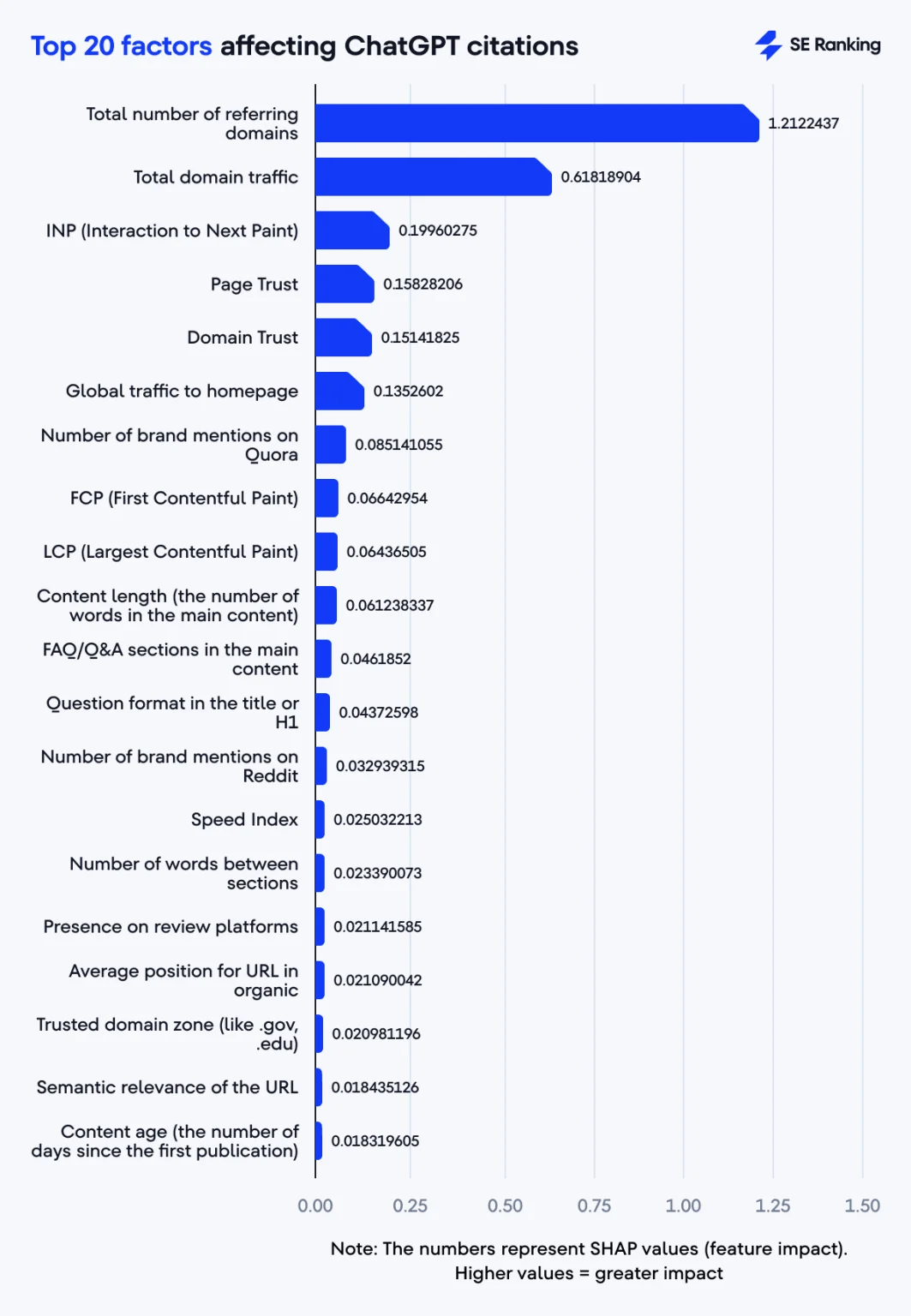
SE Ranking’s analysis of 129,000 domains across 216,524 pages found that referring domains — the number of unique websites linking to yours — is the single strongest predictor of whether ChatGPT cites a site. Sites with up to 2,500 referring domains averaged just 1.6–1.8 citations. Past a threshold of roughly 32,000 referring domains, citation rates nearly doubled, from 2.9 to 5.6. Domains with 350,000+ referring domains (think Wikipedia-scale) averaged 8.4 citations.
At that point your site will become a source that ChatGPT will cite authoritatively. We tend to think of links as a Google ranking factor, but here every URD is also a vote in the training data for ChatGPT, and the more high quality sites that link to you, the more authoritative the ChatGPT will consider your site.
Domain & Page Trust
Domain Volume will get you into the room and begin the conversation but the Domain Trust Score will determine if you have anything relevant to add. The same study found Domain Trust score follows a similar threshold pattern: sites scoring 91–96 averaged 6 citations, while those scoring 97–100 averaged 8.4. Page-level trust mattered less than domain-level trust — pages with a Page Trust score of 28 or above received a roughly comparable citation rate, suggesting ChatGPT weighs overall domain authority more heavily than individual page metrics.
So the Domain Trust Score can be thought of as akin to having a “Front Door” pass in the world of AI. Having a low Domain Trust Score is like building a house on the sand in the world of GEO and it does not matter how much you work on increasing your Domain Volume, Average Document Size or Keyword Usage in order to improve the authority of your content.
Traffic as a Real-World Signal
ChatGPT considers traffic as a human trust factor. They’ve released a couple of fairly interesting papers about the fact that traffic is an indicator of human trust in a website. It’s not that surprising, but the guys behind ChatGPT suggest that it’s a little hard to get the data they need to run user surveys in a chat app, because it’s more of a “website” thing.
They suggest that although they have got “tons” of data for training their chat app, they can use the signals that they’ve “learned” about the relative trust of different sites to train a new model about the content that they believe is trustworthy and therefore should be cited.
SE Ranking’s study found domain traffic is the second most important factor, though the correlation only shows up at high volume. Sites under 190,000 monthly visitors averaged a flat 2–2.9 citations regardless of exact traffic level — a site with 20 visitors performed about the same as one with 20,000. Only past 190,000 monthly visitors does traffic start meaningfully predicting citations.
The Gov /Edu Myth
So we have heard a ton of SEO people talking about backlinks with each other and every time they mentioned .gov and .edu links they made them sound like the rarest and most amazing things in the world.
The same study found .gov and .edu domains didn’t outperform commercial sites — government and educational domains averaged 3.2 citations, compared to 4.0 for sites without a trusted-zone designation. As SE Ranking put it: “What ultimately matters is not the domain name itself, but the quality of the content and the value it provides.”
Who knew the state wouldn’t be able to muster together enough website infrastructures to help a sentient language model learn? Meanwhile a decent website with adequate content and reasonably-sized text is apparently all the stuff you need to train ChatGPT. The .gov and .edu really don’t matter as much as you’ve been told.
Social Proof & Third-Party Validation
Traditional SEO has always focused on the content you have on your site, and the structure of that content, to try and rank your pages in the search engines.
However, with the arrival of AI, there is a new factor that you need to be aware of: other people’s content can be far more important to your SEO than the content on your own site. One key difference between ChatGPT and other chatbots is that it doesn’t just look at what people say about themselves — it also considers what others are saying
These are Consensus Machines. They determine the most frequently and consistently discussed information about your brand across the web and then form an opinion. If people are naturally and organically talking about you online (reviews, mentions, references) then you will be considered the most relevant result for that search before your website has even been seen by the Search Engine.
Quora & Reddit Mentions
SE Ranking’s data confirmed Reddit and Quora as strong citation drivers. Domains with minimal Quora presence (under 33 mentions) averaged 1.7 citations, while heavy Quora presence (6.6 million+ mentions) corresponded to 7.0 citations. Reddit showed a similar pattern — domains with 10 million+ mentions averaged around 7 citations, versus 1.8 for minimal activity.
This explains why mid-sized brands with a relatively small backlink profile can outshine their larger competitors.
The reason is that they have built a social community around their brand that their competitors overlooked. Note that we are not advocating for spamming the site with links, and we don’t expect to get modded to -10 by the community and banned by the AI. Rather, we believe that the way to succeed is to contribute value to the site and to build trust with the community. This way, when people have something relevant to say about your brand, they’ll naturally mention it in the appropriate context.
Review Platforms
So how do you decide to use a business for the first time? Reviews! You want to see a lot of reviews from many different people saying the same things about a business. That is exactly what ChatGPT does. Having a business listed in review sites like G2, Trustpilot, Capterra or Yelp means that real people have interacted with the business and left reviews.
Per the same study, domains listed on multiple review platforms (Trustpilot, G2, Capterra, Sitejabber, Yelp) averaged between 4.6 and 6.3 citations, compared to 1.8 for domains absent from review platforms entirely. So claiming and optimising your business listings in relevant review sites for your GEO should probably be your number one priority this week.
“Best of” Lists & Authoritative Mentions
The one type of content that ChatGPT loves to scrape from other sites are third-party roundups. “10 Best Project Management Tools”, “The Top CRM Software According to Experts”, or even the Wikipedia entry for your industry category. Consensus is what an AI engine is designed to reflect. And that’s what you vote for every time you get mentioned in one of these respected category roundups.
Every time your brand gets included in one of these lists you’re voting for yourself and the AI is tracking those votes the next time it recommends businesses like yours. And that’s why digital PR has become one of the most high-leverage GEO activities of all you’re not just building backlinks, you’re building consensus.
Content Depth, Structure, and “AI Digestibility”
When you write for an AI, there’s more to it than what’s in the words. When you write for ChatGPT, you need to bear in mind that the model won’t engage with your content in the way a human would. Instead, it will look for patterns in the text to work out what it is supposed to be picking up, it will attempt to automatically extract data into forms it can use, and it will try to get through what you’ve written as quickly and efficiently as possible before losing focus and giving up. So, this is a good reason to make things easy for it.
Content Length & Depth
Length tells us that articles under 800 words have an average of 3.2 citations, while those that exceed 2900 words are cited an average of 5.1 times. However, as we’ve learned from our training and testing of ChatGPT and the importance of using lists and other informative, editorial content as opposed to long marketing descriptions, the wording and structure of the content is what truly matters.
While you can ramble on for 4000 words extolling the virtues of your product, a well-researched and well-organized 2000 words that clearly describes the problems your product solves can yield amazing citation counts.
Optimal Section Length for AI Parsing
At first glance this seems like an extremely fine grained metric but it makes sense when looking at the data. The optimal length for a piece of text that the model can work with is between 120 and 180 words which works out to approximately 4.6 citations per section. Too short and there’s not enough content to get any useful results from it, and too long and you’re just left with a stream of text without any separation between answer potential.
Ideally each section of text should be able to act as a fully formed answer on its own without the need for additional input or context. It should be long enough to carry meaning and be able to sustain itself as a full and complete answer, but no longer than that. That’s good writing and that’s what the model is looking for here.
Information Density
The more generic the content, the harder it is to generate references. ChatGPT works best with content that tries to sound important and focused by including real numbers, expert opinions and case studies. Our analysis shows that pages with quotes have on average 4.1 citations, while pages without quotes have on average 2.4 citations. Pages with 19+ data points have on average 5.4 citations. The more abstract the numbers, the less there are quotes and examples – the harder it is for the AI to generate a relevant answer. Being good at GEO and being good at your subject matter are not different things.
Straightforward vs.Question-Format Headings
For the last few years, we’ve recommended that headings be written as the questions that readers would ask, but the data shows that descriptive headings are far more citable with 4.3 citations per title on average vs. 3.4 for question headings.
Why are descriptive headings more citable than question headings? It’s because the AI that indexes content is trying to find the best evidence that the author of the content is an authority on the topic it’s about, and the descriptive heading usually offers more compelling and useful evidence of the author’s authority on the topic than the question heading.
So while a descriptive heading like Domain Authority and AI Citation Rates will be cited far more often than a more basic heading like What Is Domain Authority?, the former will not be read, nor will they lead the reader to the content of the page. The masters get cited. The explainers get read, and then skipped.
FAQ Sections
We often build FAQs to help train the model to understand user intent and to provide some basic answers. But there’s really only so much a FAQ can cover and in general a FAQ with 10 Q & A’s will only be referenced about 3.8 times per month on average vs 4.1 times for a more in-depth page of content.
FAQs are there to help support your content rather than replace it. A much better approach is to develop a much more in-depth guide with a FAQ section embedded within it. A page of pure FAQs leaves a ton of potential citations on the table.